

Note: the original version of this essay was published in: VVAA, Agentes culturales: Programa diplomado de formación teórico-práctico; el agente como activador-generador de la cultura en el campo de las artes visuales, Guatemala, Fundación Paiz, 2016.
“The poetic image (…) emerges into the consciousness as a direct producto of the heart, soul and being of man, apprehended in his actuality”
–Gaston Bachelard, The Poetics of Space
The political gesture can be approached from a poetic perspective, even though the poetic is intrinsically political. The gesture is an act, a state, a condition, a form. But no response to the poetic can be objective. We can only attempt to define poetics through a study of metaphysics, phenomenology, and the imagination. Only in this way can we transcend the role of the word in literature and arrive at the metaphor of the image and the gesture. I believe that art is a vessel for these gestures and a space to watch them grow and emerge. Several cardboard boxes painted sky blue (Fig. 1) or a rainbow formed by a naked body (Fig. 2) are, first and foremost, a work of art; secondly, a metaphor; and thirdly, a vessel for a poetic image to emerge from them, while simultaneously politicizing the gesture—and not merely through the use of the body.
In this essay, I am interested in offering a brief analysis of the work of artists Edgar Calel (Guatemala, 1987) and Naufus Ramírez-Figueroa (Guatemala, 1978) as bodies that manifest politically—if there is any other form of manifestation—through poetics: that unfathomable space of words and resonances.
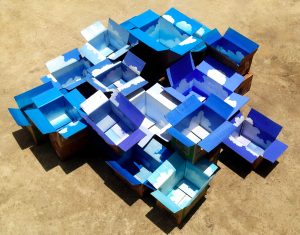
Fig. 1. Edgar Calel, Laberinto de Pájaros (“Laberinth of birds”)(2008). Image provided by Proyectos Ultravioleta.
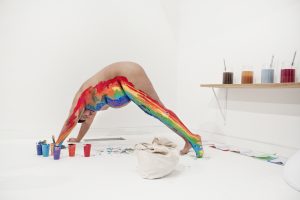
Fig. 2. Naufus Ramírez-Figueroa, Beber y Leer el Arcoiris (“Drink and read the rainbow”) (2012). Performance held at Casa de América, Madrid. Image provided by Proyectos Ultravioleta


The poetic
In order to discuss sensitive and poetic spaces, the first issue we must address is the definition of the poetic itself—the poetic outside of literature and the literary genre of poetry. We might begin by stating that poetry takes place on the level of the word and depends on it to take shape and express itself. This is why poetry belongs to literature: because it is constrained by language and can only exist within it. In contrast, the poetic transcends the realm of the spoken or written word, and it is precisely its ambiguity that lies beyond language. Martin Heidegger, in his lecture titled Poetically Man Dwells, wonders whether there is room for the poetic in our busy and mundane daily routines, or whether the poetic has been confined to poetry, which “is either rejected as a frivolous mooning and vaporizing into the unknown, and a flight into dreamland, or is counted as a part of literature”1Martin Heidegger, “Poetically Man Dwells”, in Poetry, Language, Thought. New York, Harper and Row, 1971, p. 213. Available in: http://timothyquigley.net/cont/heidegger-pmd.pdf.
If poetry exists within literature and is tangible insofar as it is visible in the word, the poetic transcends what is read and moves into the realm of the imagined. That is why, when Gaston Bachelard attempts to define the “poetic image,” he turns to phenomenology and the imagination—rather than linguistics or literary theory—and attributes an ontological character to it. “In reverberation (…) the poetic image will have a sonority of being”2Gaston Bachelard, Introduction to The Poetics of Space, Massachusetts, Beacon Press, 1994, p. xvi. Available in: https://sites.evergreen.edu/wp-content/uploads/sites/88/2015/05/Gaston-Bachelard-the-Poetics-of-Space.pdf, says Bachelard. Thus, the poetic image does not speak with words, but with vibrations that resonate.
I am not trying to prove that poetry does not use language (nothing can do without it), but what makes it possible for the sky to be kept in a box and for a rainbow to form in a body is simply poetry manifesting itself—the infinite possibility of creating resonant and vibrant metaphors that the word possesses. Bachelard has delved more than necessary into the phenomenon of the poetic image, which constitutes a simple body, “the property of a naive consciousness”3 Bachelard, op. cit., p. xix., that of the poet. But to be a poetic Being, it is not a requirement to be a poet. There is something that transcends us, like the dreams that spring from desire or the slips of the tongue that create new sounds. “It is the way of poets to shut their eyes to actuality. Instead of acting, they dream”4Heidegger, op. cit., p. 214., said Martin Heidegger in his lecture. The poetic, then, lies in the image that affects, that shocks, that tears apart. The poetic image has the power to open the body without touching it. It manifests itself in the effects it produces: resonance and reverberation, according to Bachelard. “The resonances are dispersed on the different planes of our life in the world, while the repercussions invite us to give greater depth to our own existence. In the resonance we hear the poem, in the reverberations we speak it, it is our own”5 Bachelard, op. cit., p. xxii., adds the author. Put another way, the poetic image, upon being released and perceived, creates resonances that go beyond what is read and connect it to experiences, prior knowledge, and past images; but in the r reverberation, that image returns to us and binds us, confronts us with conflict, affects the flesh, dreams, and life. A work of art, when contemplated, releases these images and constitutes them as poetic.
The political gesture
When we explore poetry and the poetic, a fundamental concept that emerges is that of the gesture. The gesture as action, as verb, as event. The gesture as eloquence or state, as intention or as act. For Mika Hannula, “a small gesture is a political act that is either visible or embedded in works of art.” But these gestures the author speaks of “are not the work of art in itself and are not the issue or theme of the work in question”6Mika Hannula, The Politics of Small Gestures, Chances and Challenges for Contemporary Art, Istanbul, Art-ist, 2006, p. 7. Available in: https://static1.squarespace.com/static/54d6681fe4b02fde3d6e646e/t/54f84951e4b0b65fe0ba0ea6/1425557841762/mikabook.pdf. They are rather a fact within the work, a form or an act that exploits its meaning and makes the experience before the work transcendent. A small gesture, Hannula continues, differs from a grand gesture because the grand gesture “wants to have a superb, everlasting, universal effect” whereas the small gesture, accompanied by others, “comes out of a worldview according to which there are no meaningful, clearcut answers of fundamental decisions”7Hannula, op. cit., p. 14.. The small gesture is thus what liberates the poetic image and allows us to ask questions and reflect, and therein lies its politics. The small gesture is political because it operates on a personal level, provokes changes in the subject, opens bridges, doors, and words; it asks questions and does not answer. The small gesture, says Hannula, is political because it “generates opportunities to think, feel, and hear alternatives (…) It is about the beauty of ordinary acts”8Hannula, op. cit., p. 16..
In the work of Naufus Ramírez-Figueroa and Edgar Calel, it is possible to recognize a series of small political and poetic gestures. This is particularly interesting given that both artists have a relationship with dreams and poetry as a starting point and source of inspiration, although this does not necessarily determine the poetic nature of their work.
In his exhibition Leer y Beber el Arcoíris (“Drinking and Reading the Rainbow”) (2015), held at Casa América in Madrid, Naufus, for example, exhibited the piece Siete Cabezas de Siete Poetas Iberoamericanos Suspendidas en el Aire (“Seven Heads of Seven Ibero-American Poets Suspended in the Air”), which consisted of seven polystyrene heads into which the public could step to look through the poets’ mouths, as if “seeing through their words”9Interview with Naufus Ramírez-Figueroa, Casa de América, March 2011. Available in: https://www.youtube.com/watch?v=YVGuP71Q6dk#t(Fig. 3). The work also addressed how Latin American revolutionary movements permeated and were permeated by poetry, as many of the poets represented—including the Guatemalans Ana María Rodas, José Martí, and Otto René Castillo—were revolutionaries in their home countries, where their writings served as a collective voice. The material of these sculptures is already a hallmark of Ramírez-Figueroa’s work, who began using polystyrene following a residency at the Akademie Schloss Solitude in Stuttgart. But it is in what that material ultimately became—a metaphor for the fragile, volatile, malleable, imprecise, and ephemeral body—that its beauty now lies. Furthermore, for Naufus, using polystyrene is a more sincere form of sculpture, as many artists use it as the base for their works and then cover it.
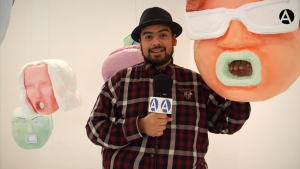
Fig. 3. Naufus Ramírez-Figueroa with his work Siete Cabezas de Siete Poetas Iberoamericanos Suspendidas en el Aire (2015) in an interview published by Casa América. Available in: https://www.youtube.com/watch?v=YVGuP71Q6dk
For his part, Calel also bases his work on reflections on language and literature. The facade of his studio bears the words “KIT KIT KIT” written in various shades of brown, a reference to his grandmother, the former owner of the house (Fig. 4). “When my grandmother arrived in the mornings, she would get up and call to the birds, saying KIT KIT KIT as she walked through the house; so there was a word that was in motion and shifted through different tones”10Interview with Edgar Calel conducted on March 13, 2016, in his studio. Video recording available., the artist mentions in a personal interview. That is why KIT KIT KIT is painted in different directions and sizes, as if the word were moving through space and receding, becoming smaller.
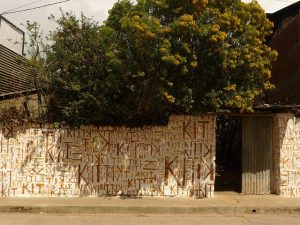
Fig. 4. Casa Kit Kit (2019), photo by Edgar and Julio Calel.
For Calel, poets such as his contemporaries in Comalapa and the Brazilian poet Paulo Leminski are important references for his work. However, although both he and Naufus work with literature directly or indirectly, it is not this that allows their works to be called “poetic,” but rather their small gestures and the metaphors they employ.
Naufus Ramírez-Figueroa’s small gesture
Studying the work of Ramírez-Figueroa and Calel is not a random decision, although the origins of both artists might suggest otherwise.
Naufus was born in Guatemala City in 1978 into a family of artists. His uncles, including the playwright René Figueroa, were involved in experimental theater and studied art at the University of San Carlos in Guatemala. One play in particular, written by Hugo Carrillo and titled El Corazón del Espantapájaros, caused an uproar due to its political and social content and its references to an oppressive dictatorship from which the people were trying to free themselves through the absurdity of a circus. On opening night, the play provoked threats from the government that forced some of Naufus’s relatives into exile. A few years later, another of his uncles, a university activist, was murdered. Thus, the artist fled Guatemala at age 6 to Mexico and then to Canada with his family.
However, Naufus’s ties to Guatemala did not disappear, and much of his body of work stems precisely from the experience of exile, the Internal Armed Conflict, and his family history. Although another part is also dedicated to the exploration of his dreams, fantasy, and conspiracy theories, which is why his work—which still has socio-political content—distances itself from denunciation, the pamphlet, and direct engagement. I believe that Naufus, precisely through his subtle gestures, hidden metaphors, and abstractions combined with dreams and fantasy, transforms the way he addresses themes such as absence and disappearance into poetic reflections: not rebellious discourses, but reflective and reconciliatory personal narratives.
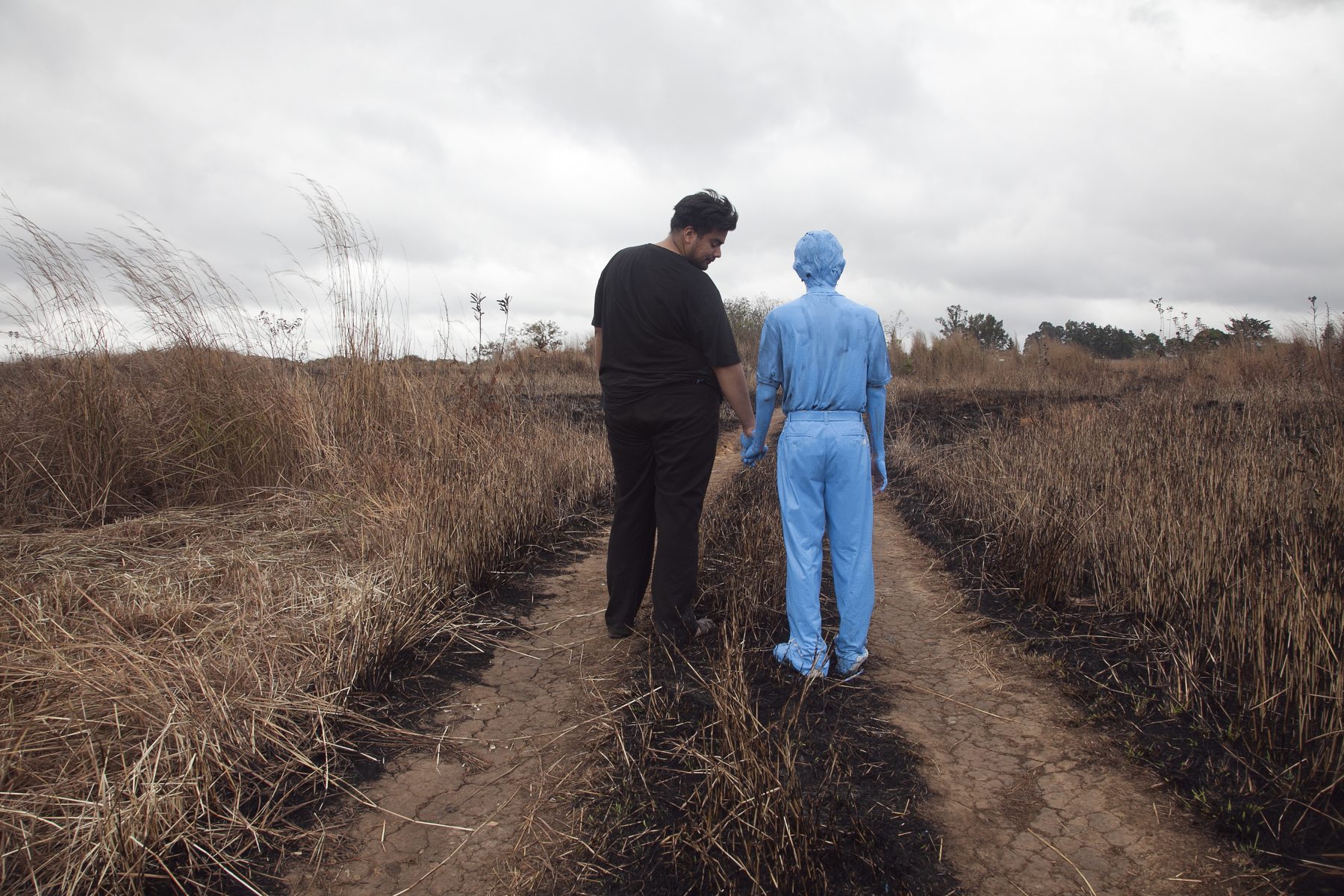
An example of this is the work Fantasma Amigable (“Friendly ghost”) (2012) (Fig. 5), in which Naufus presents his body with his back to us, dressed in black, his face slightly turned away. He holds a small figure by the hand—a body smaller than his own, painted entirely blue.The artist is dressed in black; the figure is dressed in sky, in absence, in the color of the screen (chroma key) used in film or television shoots. That figure symbolizes his uncle, the same one who was murdered at age 19, of whom only a memory or a ghost remains.
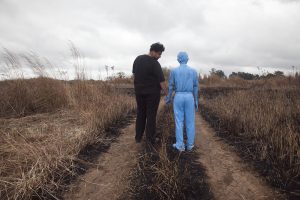
Fig. 5. Naufus Ramírez-Figueroa, El Fantasma Amigable (“Friendly ghost”) (2012). Image provided by Proyectos Ultravioleta.
In the text cited above, Hannula notes that the small gesture takes place in “the process of striving towards a certain goal. A goal that we will never fully achieve, but a goal that we want to move towards in small, significant steps”11Hannula, op. cit., p. 14.. Likewise, Naufus attempts to reach the memory of his uncle, the presence of that body whose absence or disappearance determined his own fate. Here, then, the interplay between politics and poetics unfolds, for although the theme of war and forced disappearances underlies the work, the artist’s interest is not, in the first instance, to denounce this fact, but to come to terms with it personally.
As for the composition of the work, Naufus paints the body and photographs it, so there is first and foremost a play on media: a painting as a gesture and a photograph as a record. But upon contemplating the image, the painting loses relevance as an individual act, being displaced by the color, the position, the artist’s companion, the entire act of the image. Then there is the landscape: a two-lane road between a scorched, dry plain. Naufus and his companion each have one foot on the scorched center and the other on the dirt road, as if both were walking together yet in parallel, perhaps between death and life. The artist, the living body, looks at his companion’s hand, but the ghost does not return his gaze. However, his hand is painted the same blue, as if they were truly together, becoming one. It is interesting that Naufus chose to represent absence with a present body that is nonetheless alien to the entire landscape surrounding it. Hannula’s phrase resonates once more: “a small gesture survives only along with the series of other small gestures that precede it”12Hannula, op. cit., pp. 14–15..
Edgar Calel’s small gesture
Edgar Calel was born in Comalapa, Chimaltengo, in 1987. Stories say that Comalapa is a town of artists because when the Spanish conquered Iximché, the emperor took all the artists to take refuge there. Whether true or not, the small town has a very interesting and prolific tradition of both traditional and contemporary artistic production. Calel’s work is part of this landscape, and his body of work emerges precisely from his context: his Kaqchikel roots, decolonial thought, and his personal imagination.
On the other hand, as in the case of Naufus Ramírez-Figueroa, although the starting point of Calel’s work carries a strong political charge, the artist’s small gesture and personal interpretation transform what could be an act of protest into a poetic gesture.
An example of this is the work Bandera (“Flag”) (Fig. 6): a piece he presented during an exhibition held in March 2016. Two stacked wooden pieces served as a canvas for the artist and his family to paint the Guatemalan flag. At first glance, it was a performative act. On the other hand, a second reading identifies a national symbol on a natural material that was cut in a violent manner. “It is a national representation that divides us just as each log is divided. They all come from different logs and are now united by the colors that homogenize and nationalize them”13Interview with Edgar Calel conducted on March 13, 2016, in his studio. Documentation available on video., the artist comments. Thus we have three elements: first, the size of the wood; second, the cut; and third, the color.
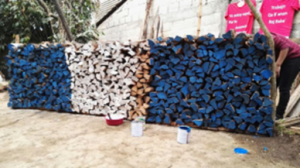
Fig. 6. Edgar Calel, Bandera (“Flag”) (2016). Photo by the author.
I believe that the small poetic gesture underlying the political nature of this work lies in Calel’s decision to invite his family to paint the flag. During the exhibition, there is a gesture of reconciliation with the violence of the act of cutting that remains cynical in its conception, since those who set the nationalist homogenization in motion are the artist’s own family members. This small gesture also emerges in the material itself as a metaphor for the population: that the pieces of wood, torn from different trees, are presented as the individuals who make up the social body is a prosopopoeia that opens up the possibility of broad interpretations of our behaviors as a society and the symbols under which we converge as a collective. Violence lies in the gesture of homogenization, as well as in that of segregation.
Like Naufus Ramírez-Figueroa, Calel focuses on abstracted, metaphorized political discourse. Both approach a reality they wish to problematize and rework it based on their own imaginaries, which stem from dreams, poetry, and the gesture that provokes adversity, empathy, and reflection. The small gesture becomes politicized the moment it demands personal reflection from the viewer and allows them to intuit a universal reality related to the fragile and simple human condition. “For a grand gesture,” says Hannula, “the act is an end in itself,” whereas for the small gesture there is never a closure or an end. It is an eternal gesture in that the memory it evokes is perpetual. The small gesture is sensory, corporeal, and also possesses an immaterial presence that is felt and confronted.
Undoubtedly, a deeper and more extensive reflection is needed on the poetic conditions of the work of these two artists, for whom poetics is never bloody nor does it shout directly. Their metaphors wait, spread out, and contemplate from the unconscious and dreams how to use words to “poetize” the gesture, to abstract it and render it ambiguous, or to reduce it to the simplest aspect of the complex. The resonance of the poetic image described by Bachelard is what emerges from any reading of the work of Naufus and Calel, which fulfill their function as “political works” in terms of themes and starting points, but which exceed and transcend the limitations of commitment and abstract themselves to please themselves. Both artists are beings who have small things to denounce on a grand scale, through small poetic gestures and grand metaphors, and who affirm that “the poetic is the basic capacity for human dwelling”14Heidegger, op. cit., p. 228., as Heidegger posits.


