

If there is one thing that connects all of Juan Pablo Langlois’s (JPL) projects, it is a desire to disrupt the familiar. Over the years, and through his works, the artist has found ways and means to bring this about: by taking up space, focusing on a notebook, or becoming obsessed with a building. This exhibition is an attempt to explore Langlois’s relationship with the National Museum of Fine Arts of Chile through three projects he developed between 1969 and 1990: Cuerpos Blandos (“Soft bodies”) (1969), Monumentos (“Monuments”) (1971), and Diario de vida recortado (“Cut-Up Diary”) (1990). I decided to approach these works through a journal of notes and impressions that I wrote down over the past few months while looking through the artist’s archive, without offering a hypothesis or conclusive idea, but rather just a few insights into his working methods, the words he repeats, the materials he keeps, and the categories he writes on his envelopes and lists.
1- DIARIO DE VIDA RECORTADO
—The first document I find in the JPL archive contains the words: concepto (“concept”), material (“material”), montaje (“assembly”). There is a sense of planning, a thought process preceding each action that is documented and carefully preserved. However, it seems that his process-oriented spirit never ends —neither with the unveiling of the works nor with the completion of the action. To me, the mystery of JPL lies in the fact that the work is always in the process of being assembled —that is, it is always open to a new version, available for further reflection. Taking notes is a common practice of the artist that can be traced in his documents, in which he leaves clues that he later revisits, as if the archive were a place where he can leave impressions anew —a place to return to not to verify something, but to continue reflecting on his own practice.
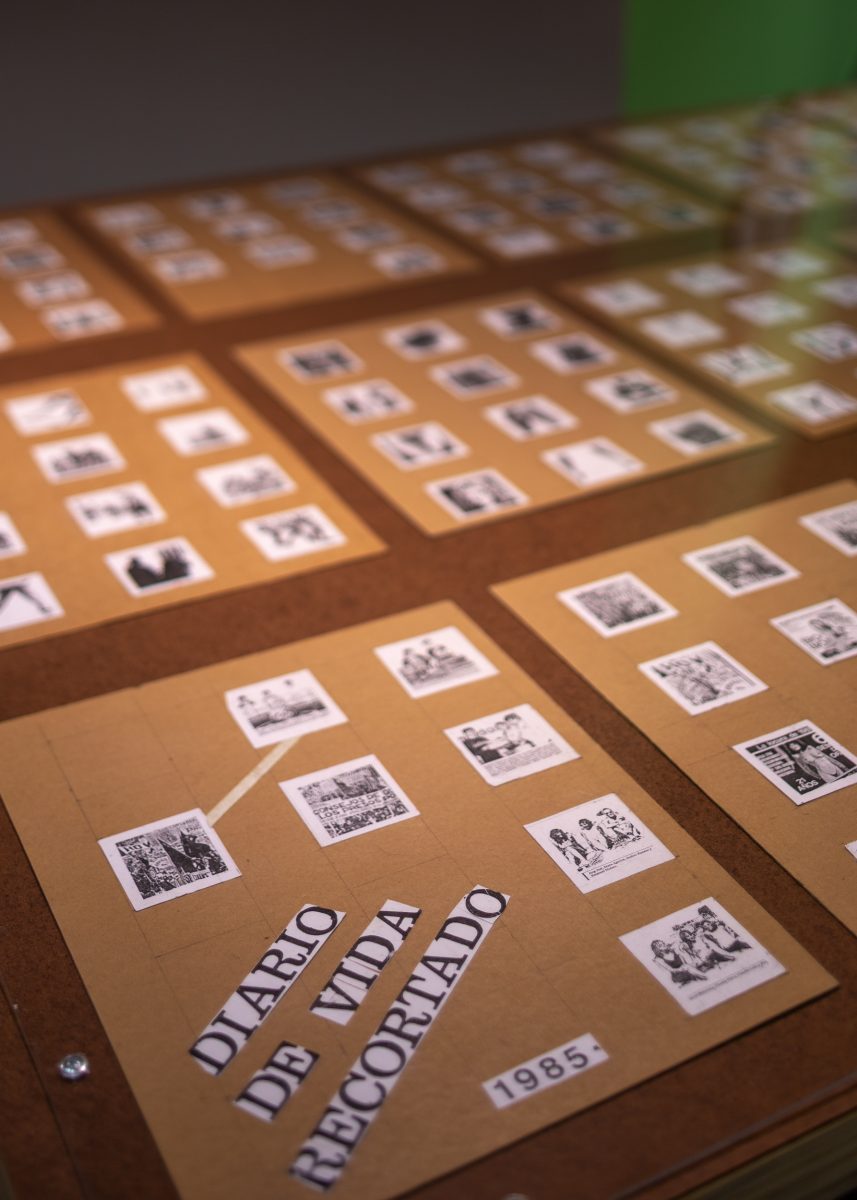
—I start with Diario de vida recortado. Although it isn’t his first project, it offers some guidelines that relate to these three concepts: “concept,” “material,” and “assembly.” JPL’s initial idea was to unfold “everything a newspaper contains” through these three actions. The first version of this work was created in 1989 on the facades of the Chilean-French Cultural Institute and the building located at the corner of José Victorino Lastarria and Rosal streets in Santiago. Six hundred images in three different sizes (7 x 7 cm, 10 x 10 cm, and 14 x 14 cm), taken from various newspapers from 1985 —the year the artist began working on this project—were glued to the walls of these buildings, arranged in horizontal and vertical lines. A form of media muralism. The precursor to this intervention was a work that JPL presented at the 1985 Valparaíso Biennial, which consisted, as he himself explained, of exhibiting “60 original objects (figures) made of modeling clay, resulting from repeating 12 prototype figures five times, each measuring approximately 30 x 20 x 12 cm.” Newspaper was already present there, not only as the material used to model the figures, but also as the surface on which they rested.
—What do the centimeters of separation between images in Diario de vida recortado signify? What do the sizes of each image tell us? “To communicate without understanding,” says JPL.
—That same year, 1989, the facade of the National Museum of Fine Arts appears in another project by JPL. It is titled Carnet múltiple (“Multiple ID card”) and has its roots in the 1980 work Carnet sentimental (“Sentimental ID card”). In this project, JPL proposes painting 50 copies of his ID card one by one —given the legal prohibition against making color copies—and writing a different text on each one (for example: “ELIGE TU VIDA MÍA” or “TERREMOTO-PLATA O EL ASILO CONTRA LA OPRESIÓN-PICLE O PISCO SOUR”). He then proposed inviting 50 people to an event in a public space, specifically suggesting the Museum of Fine Arts as a possible venue, which at that time had a sign on its facade reading: “CLOSED FOR RENOVATIONS.” Once there, each of the 50 attendees would receive one of the ID cards, and, standing in front of the sign, everyone would read the text on each document at the same time. The action never took place “due to a lack of official authorization.”
—I notice that in many of JPL’s works, the floor appears as a conceptual support for the artwork. Not only to divert the gaze from the work’s usual field of view, but also as a space for mobility: the floor as a work surface, as a place to support or set aside an idea, which can be moved and changed if necessary.
—JPL often refers to the historical role that artworks engage with, noting that this role must always account for the margin within which the viewer’s thought enters. There is always a proposal for an independent visual reading that contrasts with the language of the word, the theme, and the execution —which lends an air of rigidity and structure to the artist’s projects and works.
—In the book in which Langlois documents the first version of Diario de vida recortado, he mentions that the theme of the work “is the shift from a customary reading of newspaper news to a new reading of that same news—cut out and separated from its original context, but also transformed into a permanent image-sign.” Many of his works state their “theme,” but I wouldn’t take this so literally. I would replace the word theme with the term subject to better understand what Langlois is trying to convey in that supposed descriptive objectivity, typical of a catalog entry. When JPL presents the “theme,” he also presents the framework within which his humor and mood operate, before moving on to the materials and montage that set the tone.
—A certainty gradually emerges: that this may be a story about an obsession —JPL’s fixation on a building, the National Museum of Fine Arts.
—In the version of Diario de vida recortado that JPL presented at the National Museum of Fine Arts in 1990 (Figs. 1 and 2), as part of the exhibition Museo abierto (“Open Museum”), themes and sections appear. North section, south section, floor section. Themes: feet, sex, animals, housing, the street, horse racing, sports, queens, police. Several crews of people participated in the installation of the work: some carried the papers, others brought paste to stick the images to the wall, and others went over them with glue, making sure they were securely attached. A media crew, affixing to the wall disjointed fragments of the story of a single day —or many days. The 600 images installed on the facade of the “Bellas Artes” building measured 20 x 20 centimeters and were placed 1.5 meters above the ground. JPL says there was a lot of work, thought, and order involved in this installation process, but also a great deal of chance, fun, and spontaneity. “Many of us have worked and pasted photocopies, but what made this work different from any other? Perhaps its 300-meter length, its continuity, perhaps the chosen height, or the obsession with finally installing it after a year of rehearsals and challenges?…” he wonders. In his testimonies and in his archive, there is a clear desire to bring projects to fruition —many of which require permits, paperwork, and bureaucracy— and there is also a vague focus on the question: what’s the point?
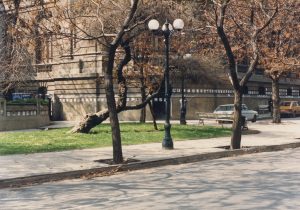
Fig. 1. Instalación de Diario de Vida Recortado en fachada del Museo Nacional de Bellas Artes de Santiago, 1990.
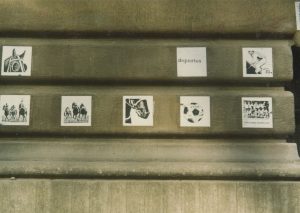
Fig. 2. Instalación de Diario de Vida Recortado en fachada del Museo Nacional de Bellas Artes de Santiago, 1990.
—The photocopy: based on Diario de vida recortado, one could reflect on the history of the material, the history of weak reproduction: the photocopy and pasting, conceptual art, or anti-conceptualism.
—Among the categories that emerge in this work, the following stand out: “Stress” and “Sex.”
—It’s impossible not to think of the Manifiesto de Arte de los Medios de Comunicación (“Manifesto of Media Art”) that Roberto Jacoby, Raúl Escari, and Eduardo Costa published in 1966, announcing that they intended to “derealize” objects, carrying out and disseminating a nonexistent event in the mass media. “A work that begins to exist at the very moment the viewer’s consciousness perceives it as already completed,” they declared in their text. In JPL, the decontextualization of news stories, their images, and their exact publication dates gives rise to a shift that also creates “nonexistent events.” Both, with their own particularities, highlight a responsibility on the part of the media, except that Arte de los Medios favors clear statements, while JPL favors ambiguity and loss. Many years later, Jacoby, together with Syd Krochmalny, created the work Diarios del odio (“Hate diaries”), a mural composed of fragments of comments posted by readers of online versions of Argentine newspapers (primarily La Nación) and written on the walls of the National Arts Fund hall in Buenos Aires. While in Jacoby’s work the media are highlighted as a threat to people’s emotional states, in JPL’s work they represent the power to reconfigure the world and personal subjectivity. One emphasizes the phrase, while the other opens up the possibility of creating something different with it.
—In a later work by JPL titled Mi suelo (“My floor”) (1996), I see a background of newspapers and glued-on papers that form an irregular shape. Facing it are two female figures. I think an idea for this exhibition could be to completely cover the gallery with today’s newspapers, following something of the way this work was presented. I think of the support structure as a way to evoke the newspaper and the act of reading it. The support lends speed, immediacy, and a sense of time that the wall cannot convey.
—In JPL’s archive, there are some envelopes containing loose materials. Among the papers outlining the Diario de vida recortado project, there are also other newspaper clippings —possibly leftovers, ones that weren’t used— which he saved and sorted by size and dimensions.
2- CUERPOS BLANDOS
—I like to think of those “pools of boredom” that JPL mentions in an interview with Ana María Risco as the possibility of opening up a conceptualism of tedium. Between the necessity of the work and the absurd and unnecessary, JPL’s work navigates these doubts and finds in displacement the key to its own continuity and change.
—Just as these works were created both inside and outside the museum, they were also conceived and exhibited both during and after the dictatorship. And this interpretive framework is, to a certain extent, the one that has predominated when approaching them. They were also works conceived within the archive, in their own time, and projected outward from it through the artist’s books that JPL produced throughout his career. His works must be understood within this back-and-forth, not as fragments, but as part of a single movement.
—Looking through the artist’s book that documents the production and exhibition process of Cuerpos blandos (1968–1969), I find materials that raise new questions. Although this work is one of the most studied in JPL’s career, the diversity of the material available there, along with the annotations and texts, sparks new thoughts. The work’s origin is associated with an act of liberation, without any public intention, and the focus is on the action of stuffing the polyethylene sleeves with newspaper until they attain the sculptural rigidity that allows them to occupy a space (Fig. 3). “Without preconceptions and without a preform,” he says. The work, which occupied several rooms, hallways, and the facade of the Museum of Fine Arts, was nevertheless removed and piled up in the museum’s storage areas alongside other works (Fig. 4). While the time spent creating this work was extensive, its exhibition period was brief. I like to think of these two timeframes coming together, and of a third timeframe —that of the work after its exhibition: the time of the returning myth, of academic studies, of the expansion of artists’ references and allusions. Amalia Cross sees in the unexpected encounter between Cuerpos blandos and the plaster sculptures that were in the Museum of Fine Arts’ storage area in 1969 a glimpse of the rather transgressive way in which JPL approached sculpture throughout his career.
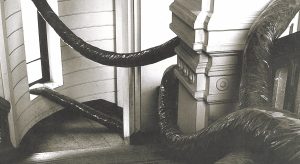
Fig. 3. Juan Pablo Langlois, Cuerpos Blandos, 1969.
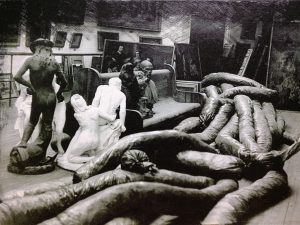
Fig. 4. Fotografía de la obra Cuerpos Blandos en los depósitos del Museo Nacional de Bellas Artes, 1969.
—Alejandro Martínez says that “Juan Pablo Langlois intervenes in the National Museum of Fine Arts as a way to reactivate the political dimension inherent in Cuerpos blandos and to reclaim that interstitial space between the museum and the city as a political site.” I also think that his insistence on intervening in the museum’s facade is an indication that the “outside” is more visible and effective than the “inside,” which remains a space where fiction runs rampant.
—The numerous drawings that permeate his works and actions reveal that this is a project with channels open to other ways of understanding the exhibition space as it opens onto the landscape. If this marks the beginning of JPL’s relationship with the National Museum of Fine Arts, it also marks the beginning of a somewhat more surreal approach to design, one without precise control over what is imagined and what is realized.
—The artwork proposes a specific use of art. JPL seeks to provoke the viewer into making use of art in a way that differs from the usual. In this sense, his work is avant-garde, in the same way that it embraces conceptualism in the South. JPL aims to build and dismantle expectations through his work: there is no protection of mystery here, but rather a use of mystery —without shying away from revealing it.
—Conceptualism as a ministry: JPL’s archive is, at first glance, full of humor. And the Fine Arts Museum appears there as the headquarters of the ministry that the object seeks to occupy —an object that is more mysterious than concepts and ideas.
—The notebooks serve as guides for navigating JPL’s archive, yet they also resist full disclosure. As JPL explains how he does things, recounting the steps and organizing his thoughts into categories, he simultaneously disrupts the objectives, references, and history of art. And just when everything seemed to be leaning toward the concept, he returns to the material. Conversely, when everything was about materials, the idea comes to the forefront.
—Amalia Cross refers to a text published in the magazine La Bicicleta in 1979, written in collaboration with participants in the Arte actual seminar organized by Nelly Richard, where JPL’s work is situated within the “isolated manifestations of rebellion against an established order.” I believe that this attitude of rebellion was not directed against an order, but rather responded to a need for surprise in the work. This is evident in the uncontroversial tone of JPL’s accounts, though he is by no means unaware of the political commitment inherent in his work. It is this need for surprise that brings JPL’s work closer to the surreal connection it maintains with objects and everyday life.
— In one of his ring-bound notebooks, JPL sketches a diagram with colored markers titled vicious circle, in which he names Borges, Duchamp, Apollinaire, Atkinson, and Baldwin as part of a genealogy that has neither a specific beginning nor an end. Following that is a note: Creación del mar- el centro- la cordillera (“Creation of the sea—the center—the mountain range”). Followed by a drawing by his son. Followed by the phrase el arte no es una respuesta, es una pregunta (“art is not an answer; it is a question”). Followed by notes on time and materials.
—The avant-garde is defined by exclusion. But in JPL’s archive, it is unclear what exactly is being excluded.
—Alejandro Martínez approaches Cuerpos blandos as an expanded poem that raises questions at the intersection of architecture and poetry, creation and collection, authorship and participation, in line with JPL’s training at the Valparaíso School of Architecture and the journeys undertaken there. It is in this sense that the author conceives this work as the invention of a new interstitial space on the museum’s facade. This may be an element that runs through JPL’s work: his ability to articulate and create spaces that, at first glance, do not exist —a hallway, a facade, a sidewalk. Transit spaces offer a more active flow for the artworks than the galleries do; the outside is more responsive to his work. The inside poses and insists on a single question: the question of art. The outside fosters confusion, blurs boundaries, and does not suffocate under the weight of meanings.
—Antonio Echeverría shows me an image of an embrace from the Nemesio Antúnez Foundation Archive. It is a photograph taken by Paz Errázuriz of Thomas Daskam, Germán Arestizábal, Juan Pablo Langlois, and Nemesio Antúnez in the middle of a curfew at 4 a.m. in 1977 (Fig. 5). Antúnez was returning to exile that night, where he would remain until 1984, when he returned permanently to Chile. His tenure as director of the National Museum of Fine Arts, between 1969 and 1973, had encompassed not only Juan Pablo Langlois’s experiences at the museum but also those of many other artists of his generation.
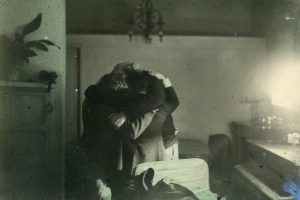
Fig. 5. Germán Arestizábal, Nemesio Antúnez, Thomas Daskam y Juan Pablo Langlois abrazados para la despedida de Antúnez, en un toque de queda a las 4 a.m. Santiago, Chile, 1977. Fotografía del Archivo Fundación Nemesio Antúnez.
—In JPL’s work, his explanations and words are intended to build expectation. And often that expectation points in a direction opposite to that of the work itself. They build and destroy expectation.
—Softening the wall, JPL mentions in a passage from the book Cuerpos blandos, could also be extended to the concept. “Is there such a thing as an opportunity for a work of art?” he asks. The facade of the Bellas Artes was one of the ways he found to engage politically in 1969. In 1971, 1985, and 1990, he found other ways.
—The exhibition as an impression of the archive on the ground.
3- MONUMENTOS
—A text that Nelly Richard wrote in 1973 for the magazine Punto Final helps me clarify a few things. That’s where the idea for the title of this exhibition comes from: Del objeto al misterio (“From object to mystery”). The text is a review of an exhibition of sculptures and drawings that JPL presented at Galería de Bolsillo. Richard describes the works on display in this exhibition as “art of situations” and “art of moments” —a space for enumeration and description without interpretation.
—One of the motives behind JPL’s interventions at the National Museum of Fine Arts seems to be to prevent it from fulfilling its basic functions.
—When JPL exhibited Monumentos in 1971 (Figs. 6 and 7), he gave a talk to the museum staff in which he mentioned the need to embrace the form of the pedestal and modify it to create a conflict with the familiar. This gave rise to: El vigía, Paisaje para el campo, Monumento para dos, Trampa para cazar perfumes, El altar de las alcobas, En el fondo hay un espejo, and other pieces. JPL clarified that to understand them, one simply had to accept them, and that this brought about liberation. I think that for him, acceptance is the foundation upon which humor is built —and that humor is also the cause and reason for liberating form.
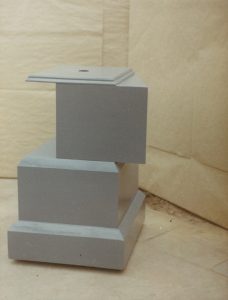
Fig. 6. Juan Pablo Langlois, Monumentos, 1971.
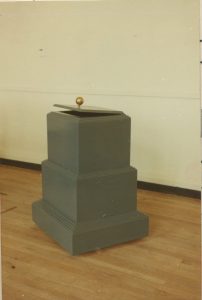
Fig. 7. Juan Pablo Langlois, Monumentos, 1971
—Some of this reminds me of Ricardo Carreira and his text La deshabituación (“Dishabituation”), probably written in the 1960s or 1970s. There he says that “every time we learn something new, become aware of previously hidden causal or formal relationships, or of a simple, unjustified alteration, a process of ‘dishabituation’ occurs. Work, magic, teaching, art, and error are all forms of ‘dishabituation.’” Carreira applied this concept to poetry, through his inventions and a few works. He argued that any act of signifying through language enabled the “dishabituation” of what was signified because it isolated it, took it out of context, exalted it, dismantled it, revealed the object’s hidden or internal relationships, and created a new exteriority. I believe this is the mystery in JPL, the very definition of mystery: to formally destroy something by making it unfamiliar, to destroy it in order to give it a new form. Those who always do the same thing become accustomed to it. In contrast, one of the functions of a work of art is to offer all these possibilities of consciousness and to generate signs and signifiers, always with the possibility that this will generate conflict.


