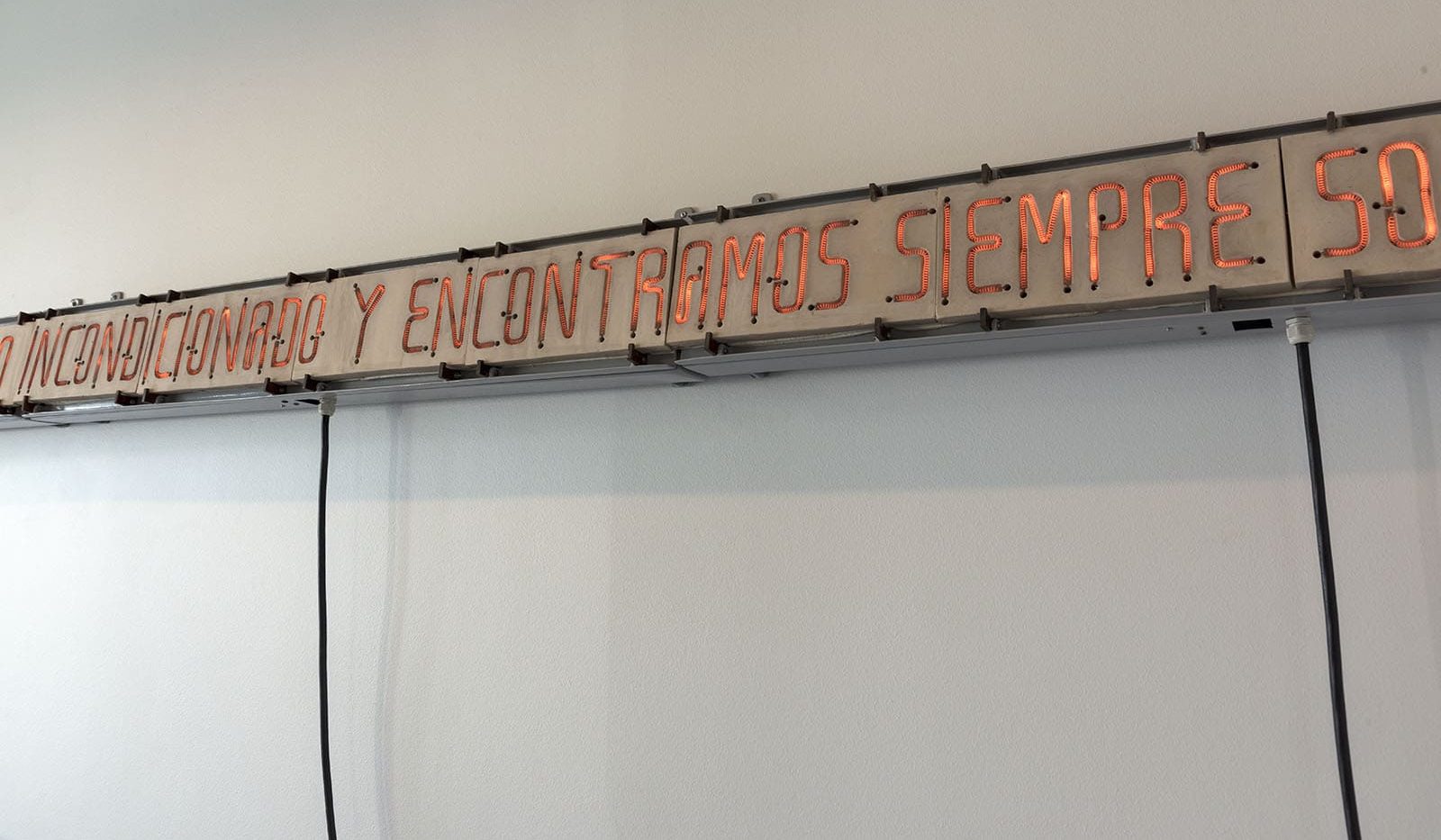
We search everywhere for the unconditional, and we always find only things. This is the quote from Novalis that Gonzalo Díaz recovers in the installation Al Calor del pensamiento (In the Heat of Thought). According to Sergio Rojas, we cannot fail to perceive here a note of the special and powerful experience of finitude that would be characteristic of Romanticism (“the demand for the unconditional,” the author reminds us, “is the way in which humans experience the transience of existence”). However, the pathos of the material and of finitude that demands the greatest sublimations appears in Díaz’s work in a reverse sense, as if it were a matter of exhibiting the insufficiency of the subject with respect to matter or the unattainable density of things.
“…what is lost in Spanish and what German has is (…) that in German the word unconditional contains things,” says Gonzalo Díaz about this work: “It is as if in Spanish I had to say we search everywhere for the unconditioned, that which can never have a body, and we always find only bodies, pregnant bodies.”