

This city is founded on a crime
-Christa Wolf, Medea1Christa Wolf, Medea (Buenos Aires: Cuenco de plata, 2015), 143
It is the year 1923, mid-winter in Santiago, Chile. The flow of the Mapocho River, swollen by the abundant rains of June, reflects the sinister gray of the clouds. On the riverbank, Ismael Gatica, a municipal worker, cleans the city’s drains, popularly called “little water boxes.” In front of one of them, he suddenly stops. There is something strange, an object stuck. The man approaches, squats down, and with both hands rips apart the newspaper wrapping around the package. Then, startled, he runs to the nearest police station. He has found a man’s leg, and his discovery marks the beginning of the famous “little water box case,” one of the most memorable in the country’s criminal history. Following his discovery come others: the torso, the right leg, the victim’s head, all scattered in different parts of the capital. However, the identity of the person remains a mystery for days. “The body must be that of a missing person,” says an officer to the press, a phrase that, half a century later, would make unexpected connections with the disappeared during Pinochet’s dictatorship. After a week of investigation and the inability to identify the body, the morgue doors are opened to the city’s five hundred thousand inhabitants. The pilgrimage outside is endless: men, women, the elderly, and children line up to inspect the pieces of the enigmatic corpse in a display with strange museum-like or gallery-like overtones. Finally, this opening leads to a clue: a man links the body to the mysterious disappearance of his colleague, the newsvendor Efraín Santander. But the most unexpected discovery is still to come: the author of the crime was a woman, also a newsvendor, Rosa Faúndez.
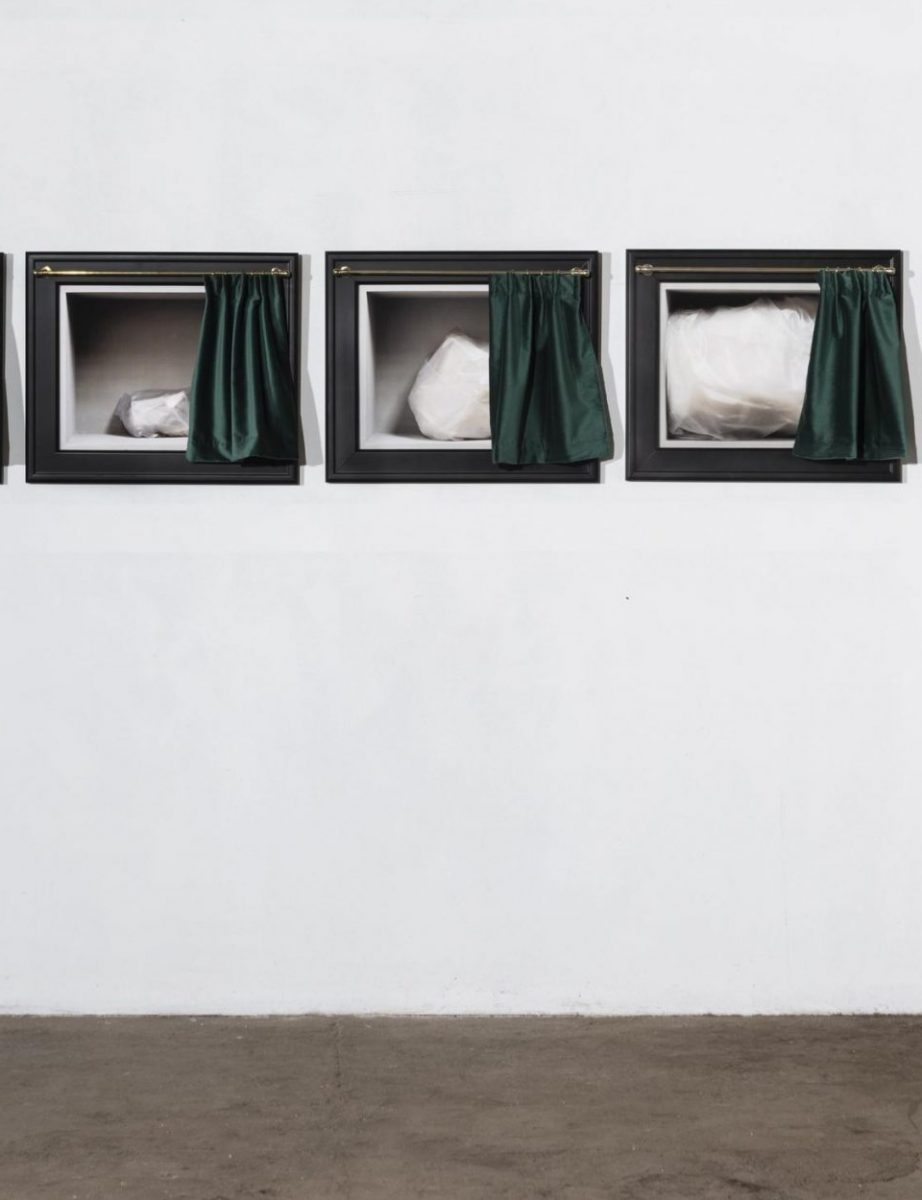
It is now the year 2003, spring in Santiago. The flow of the Mapocho has risen due to the melting snow from the mountains. Hundreds of miles away, in New York City, the doors of the Backyard Gallery open, and the viewers are confronted with an unusual staging. On the white walls, seven color photographs, partially covered by a green velvet curtain, suggest an unsettling narrative. Viewers can draw back the curtain or leave it closed. They can choose to see or not see. But if they don’t open it, they won’t know what the images hide. The photographs depict bundles of different sizes, some oval, others elongated, all wrapped in paper, covered in clear plastic, and placed inside white boxes. The work is called The Case of the Little Water Boxes and its author is Chilean artist Josefina Guilisasti.

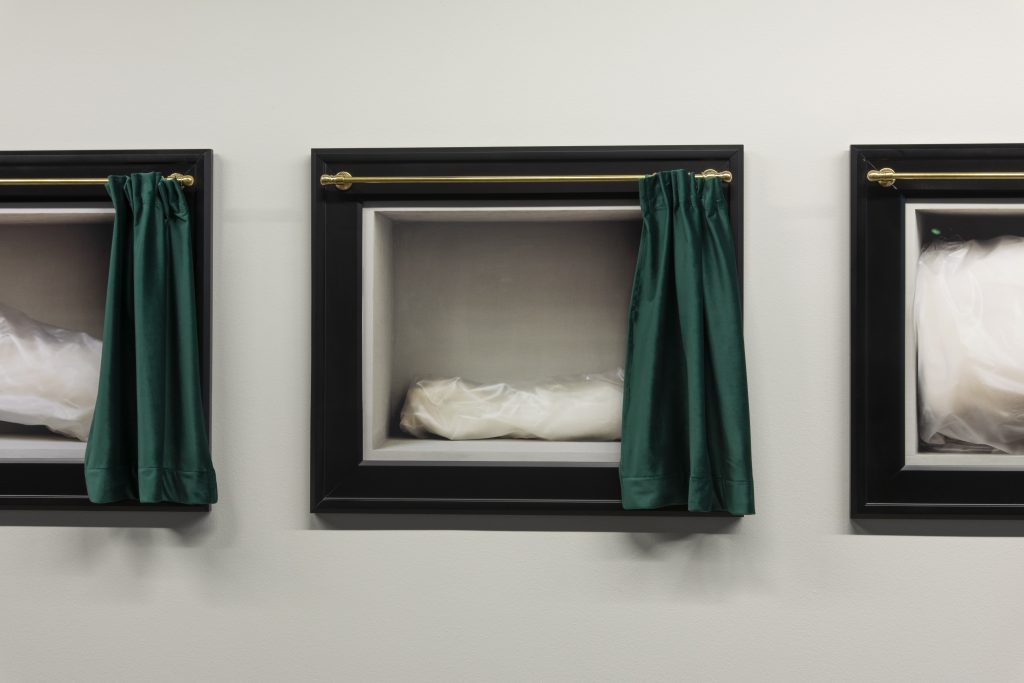
Figs. 1 and 2. Josefina Guilisasti, El caso de las cajitas de agua, 2003
It is the height of summer in Santiago, now the year 2015. The Mapocho River is nothing more than a narrow brown thread. Street mutts wander along the riverbank, thirsty. The streets become the stage for increasingly frequent and massive protests. Students. Feminists. Retirees. Environmentalists. Discussions of inequality, discontent, and a rupture in the neoliberal model fill the air, but it will still be a few years before the crisis reaches its peak. At the same time, at the Centro de las Artes 660, under the title Grado Cero, the work The Case of the Little Water Boxes is presented once again. The dismemberment of a body suddenly anticipates the schism of the country.
It is the year 2021, summer again in Santiago. In a haunting reminiscence, the Mapocho River once again becomes the site of state violence. From the Pío Nono bridge, just weeks before New Year’s, a police officer charges a protester and throws him into the nearly dry riverbed. The image of the body, face down in the thin stream of water, circulates around the world, while other images, shot and captured by Josefina Guilisasti, reappear months later at Il Posto, this time in dialogue with the works The Brick by Patrick Hamilton and Two Stones by Christian Salablanca. The doors of the gallery open and close due to the pandemic. From our homes, in front of the computer, Guilisasti’s photographs are placed in a new context. The dismembered body re-enters the domestic space, precisely where the case began in 1923. Once again, the work questions and interprets the political moment: What do these fragments represent now? What divides the Mapocho River in the city? What bodies inhabit the riverbed?

Fig. 3. Patrick Hamilton, El Ladrillo, 2018-2019

Fig. 4. Christian Salablanca, Dos Piedras, 2017
The crime committed by Rosa Faúndez would be etched into the national memory2For a more extensive analysis of Rosa Faúndez’s case, see Alia Trabucco Zerán, Las homicidas (Santiago: Lumen, 2019). The way the body fragments appeared, the mystery surrounding the body’s identity, how it was displayed in the morgue, the revelation of a woman as the author of the crime, and the symbolism of the river as a scar of a wounded city, caused journalists like René Vergara and the persistent red press to revisit this murder as an unsettling origin whenever a dismemberment was committed in Chile. This occurred with the discovery of body parts in the Mapocho River in 1973, and it would also happen with the dismemberment of Hans Pozo in 2006. In both cases, the press published detailed genealogies of dismemberment that inevitably led to “the little water box case.” However, despite being cited by the press on multiple occasions, the crime committed by Rosa Faúndez found no expression in the artistic productions of the early 20th century. The aesthetic echoes of the crime remained latent until postmodernism and its turn toward abjection, and the neoliberalism and its social dismemberment allowed for a new aesthetic explosion, which found its expression beyond the river.
Nearly seventy years had to pass, Chile’s bloodiest dictatorship, and the imposition of a neoliberal model that socially dismantled the country, for the dismembered body case to find its time, or perhaps for the times to find their case. The crime scene would be restored in 1992, in the play Historia de la Sangre by Teatro La Memoria, and later in 2003, 2015, and the current restaging of Josefina Guilisasti’s work, when this murder emerged once again as a deeply evocative milestone. The complex symbolic interaction between the individual and collective body, between the crime and the audience, alongside the aesthetic connotations of the fragmented body and its deep link to abjection, spoke directly to post-dictatorship Chile. If the play, in 1992, illuminated a zone of exclusion and questioned, in Nelly Richard’s words, “the ideal reconciliatory consensus as a forced mode of integration of the politically divided, the socially disintegrated”3Nelly Richard, Critica de la memoria (Santiago: Ediciones Universidad Diego Portales, 2010), 17, then Guilisasti’s work would serve as a metaphor for Chile’s fragmentation and to articulate gender issues absent in other readings of the crime.
Formed at the University of Chile, Josefina Guilisasti has developed a profound reflection on the mandates of painting and photography and the limits of representation throughout her prolific work. The Case of the Little Water Boxes fits squarely within this line of work. The piece reveals successive stages of production: the creation of the packages, their wrapping, and installation inside wooden boxes; the photography of these boxes and the objects they contain; the mounting of these photographs in identical wooden frames; and the addition of dark, heavy curtains, hung from golden rails.
The installation proposes a dialogue with the genre of still life, historically considered a minor genre, confined to everyday life and the domestic space. Guilisasti revisits this genre to explore representation and (dis)illusion4Pablo Chiuminatto, “Un paisaje referencial”, in: Josefina Guilisasti, Pinturas (Santiago: NeoOils, 2005), 56-71.. Several elements of the work allow for the exploration of its connection to this genre. The use of the curtain, popular in 17th-century Flemish art, acts as a historical reference to still life but also serves a concrete purpose: to provoke in viewers the illusion of entering a three-dimensional space, a box-window that they will find upon drawing back the curtain. However, on the other side of the curtain, there is neither a box nor a window. It seems to be a box, but it is the photograph of a box, captured in such a way that its shadows align with the frame, thus creating the illusion of being in front of a three-dimensional object. This is the second reference to the genre: the trompe l’oeil, where realism is emphasized to the point of creating the effect of being in front of a real object, rather than a representation.
Another referential citation is the surface on which the packages rest: boxes (or apparent boxes) that allude to a table, a key element in still life that Guilisasti uses in several of her works. In The Case of the Little Water Boxes, the table produces a sense of estrangement because of the object it holds: no longer a pot, a bowl, a basket, or a fruit, but a formless package, alluding to a crime committed on another table. If still life was a reflection, in Norman Byron’s words, on “the life of the table,” a portrait of the domestic, of the everyday act of eating and drinking, in Guilisasti’s installation, the table is ignored as a space of nourishment and interrogated as a trivial sign of the domestic, questioning the boundary between the insignificant and the exceptional by citing a criminal milestone of the 20th century that occurred none other than in the private space of an ordinary kitchen, on the surface of an ordinary table5Norman Bryson, Looking at the Overlooked: Four Essays on Still Life Painting (Cambridge: Harvard University Press, 1990), chapter 4: “Still Life and ‘Feminine’ Space”, 143-144..
The use of photography, however, although it differs from the technique employed in a typically pictorial genre, is not incidental. The work, by employing a medium supposedly closer to the real, reveals the traps of that apparent proximity and ironizes the imitative desire of still life. And to accentuate the effect of reality, the artist adds a curtain, a real fabric, which veils the packages a second time6Pablo Chiuminatto recalls in his text about Guilisasti a famous legend narrated by Pliny in his Natural History: a competition between painters where the winner would be the one who could deceive the best. According to this story, one of the artists, Zeuxis, painted a bunch of grapes so perfect, so real, that birds came close to peck at the fruit. But immediately, his rival Parasio presented a painting of a curtain, a curtain so real that Zeuxis himself asked him to pull it back in order to see the true painting. In her work, Guilisasti shifts painting and replaces it with photography, a medium supposedly closer to the real, but in this case, it reveals the traps of that supposed closeness.. In this way, Guilisasti withdraws the represented object twice in a succession of appearances that invites a reflection on the history of representation, the bond between art and reality, and the relationship between presence and absence.
But the density of references does not stop there. The content of the photographed packages, in contrast to what occurred during the journalistic coverage of the Rosa Faúndez case, is veiled in Guilisasti’s work. The reference to bodily fragments is present in the title and description of the installation, but the limbs are not visible. And this absence is also a quote from a key feature of still life: the removal of the human, the alteration of the pictorial point of view, where the dominant perspective is no longer the individual’s gaze upon the world but rather a world of objects that usurp the visual field and seem to return our gaze7Bryson, Looking at the Overlooked: Four Essays on Still Life Painting (Cambridge: Harvard University Press, 1990), chapter 4: “Still Life and ‘Feminine’ Space”, 143-144.
In addition to these referential dimensions, Guilisasti relates to another key theme of contemporary art: abjection. “The postmodern body,” says Linda Nochlin, “is conceived solely as a fragmented body; the very notion of a body of a defined and unique gender is considered suspicious”8Linda Nochlin, The Body in Pieces: The Fragment as a Metaphor of Modernity (Londres: Thames and Hudson, 1994), 57. This is a turn that Guilisasti seems to simultaneously allude to and elude. Despite the operation of concealment over the supposed bodily fragments, the title of the installation and its reference to the murder of Efraín Santander evoke the presence of a corpse. And a corpse, though veiled, maintains its abjection as belonging to an intermediary zone: non-object/non-subject. Guilisasti precisely explores this boundary. Her work evokes the fragments of a body, but instead of representing them directly, she hides them. And the concealment plays a crucial role in the work. The materiality of the wrapping indicates this. The plastic, of a certain thickness and opacity, tactile like the still lifes themselves but less neat and translucent than the glass, crystal, or mirrors typical of the genre, evokes a membrane: a boundary between the interior and the exterior, the visible and the invisible.
But the play of visibility does not stop there. If Rosa Faúndez, after strangling her husband, had covered Efraín Santander’s face with a handkerchief to avoid facing his gaze (that gaze, also bordering, present and absent, characteristic of a corpse) and later, in the morgue, had denied for a second time identifying the body fragments, in Guilisasti’s installation it is no longer necessary to close the eyes because it is the very object that is covered. The fragments are removed from view, making every package, every wrapping, every act of concealment a sign of the threatening presence of the abject.
This allusion to abjection is accompanied by an elusion. Guilisasti seems to disappoint the expectations of an art anchored in abjection, a current that returns to the body as something fragmentary, residual, and decaying. In other words, Guilisasti moves away from what Rosalind Krauss has called “the insistence on abjection as a mode of expression”9Rosalind Krauss, Formless: A Users Guide (Cambridge: MIT Press, 1997), 237. She shows without showing, forcing a reflection on what the viewers project onto the veiled image. The visual removal of the body and its replacement by clean, nondescript packages, without a drop of blood, which also do not clearly indicate a correspondence with the various body limbs, seems to critically address the contemporary turn that Paul Virilio has called “the conformism of abjection”: a desensitization derived from excess, an emptying of violent images that would have produced a senselessness, a conformist succumbing in art10Cited by Glen Close, “Corpse Photography in Roberto Bolaño’s Estrella distante and Cristina Rivera Garza’s Nadie me verá llorar”, Bulletin of Spanish Studies, 91.4 (2014): 595-616. Guilisasti’s operation separates itself from this current. By removing the dismembered body from the visual scene, the artist poses a question: if what we project inside those packages is not, also, another stumble of the eye? Another trap of representation? Rosalind Krauss, in a brilliant critique of the uses of the theory of abjection in contemporary art, argues that in the last decades of the twentieth century, there has been a problematic association between the abject and various forms of the wound. And she suggests that, even in cases where the female subject is not clearly present, she is always the wounded, victimized, traumatized, and marginalized subject in this current. Her critique, rooted in a rereading of Julia Kristeva (whom she accuses of “fetishizing the semiotic”), is suggestive in this case. Guilisasti removes any reference to the sex of the dismembered body, an aspect that had been determinant in the crime referenced by the artist.
Her operation is provocative. By obliterating any gender mark through paper and plastic wrappings, Guilisasti seems to deny the fetishization of the body and its supposed link to the feminine. However, if Krauss is correct and even in those cases where the female subject is not on stage, she is alluded to as a wounded body, as the locus of the wound, Guilisasti’s operation is more ambiguous as it removes a male body and makes it indeterminate. The concealment, therefore, would not guarantee the break from the problematic link between the feminine and the wounded. However, due to the dense referentiality of Guilisasti’s work, which repeatedly invites questioning the meaning of the very representational act, this connection between the feminine and the wounded is subject to a question mark.
If we add to this the fact that the direct reference of the work was nothing less than the murder of Efraín Santander, a male subject from the working class, the veil in Guilisasti’s work extends to this male subject. This potential substitution of the location of the wound raises a new question: about the representability of the popular male subject and the contemporary implications of the act of invisibilizing (covering, veiling, not seeing) an other who becomes abject in the new neoliberal context and, more so, in the present of a radical crisis of that model. This possibility, expressed as latency in the ambiguity of the fragmented subject’s sex, enhances the evocative power of El caso de las cajitas de agua.
The visible and the hidden, the real and the represented, are in constant tension in the work. Guilisasti stands in a self-referential zone of artistic practice, a space that allows her to simultaneously practice and question the genre of still life, accounting for its limits, its zones of indeterminacy, and its operations of assembly and disassembly. Guilisasti re-edits the trompe l’oeil typical of the genre, but does not truly intend to deceive. The artist seeks, according to critic Pablo Chiuminatto, to generate a reflection on the artistic experience as disenchantment. An exploration “of the mechanisms of articulation of appearances”11Pablo Chiuminatto, “Un paisaje referencial”, Josefina Guilisasti, Pinturas (Santiago: NeoOils, 2005), 56-71.
This point is particularly fascinating in her work. If the series of appearances (photographs that seem three-dimensional, boxes that seem to be tables, packages that seem to be limbs) invites reflection on the traps of representation in art, the reference to a crime committed by a woman labeled by the press of the time as masculine, a false woman, also allows thinking about the mechanisms of articulation of appearances when society faces female violence. El caso de las cajitas de agua, by Josefina Guilisasti, not only tensions the relationship between art and reality. It also proposes a sophisticated critique of the traps of representation regarding gender well beyond the sphere of art.
The stumble regarding the gender of the corpse becomes even more significant in a context where feminism has repeatedly made visible the dimensions of male violence that result in dozens of murdered women. Thus, in a curious effect, feminism itself reestablishes the corpse-woman association, but no longer in terms of fetishization but of denunciation, while the corpse-man association, nearly one hundred years after the crime, refers to a masculinity fractured into artificial divisions such as mind/body, rational/emotional, which have produced masculinities defined by violence and marked by this division.
In this re-presentation of Josefina Guilisasti’s work, exhibited alongside works by Patrick Hamilton and Christian Salablanca, the metaphor of a fragmented territory, of a socially decomposed body after four decades of neoliberal precarization policies that dismantled the country’s social fabric, is further emphasized. And its relevance only grows after the social revolt of 2019. This, on one hand, highlighted that fracture and, on the other, began a process of political and social rearticulation that had been dormant for decades and that has had feminism as one of its main motors of reconfiguration. The work, thus, proposes a reflection on the marginalized, the dismembered by that transparent and cold idea of the country that tried to impose itself in the Chile that sought the iceberg as its most accurate metaphor at the Chile Pavilion in the 1992 Universal Exposition in Seville12Tomás Moulian, Chile actual: Anatomía de un mito (Santiago: LOM Ediciones, 1997), 21. “The iceberg represented the debut of the New Chile, cleaned, sanitized, purified by the long journey of the sea. In the iceberg, there was no trace of blood, of the disappeared. There was no shadow of Pinochet. It was as if Chile had just been born,” wrote sociologist Tomás Moulian after the Seville exhibition where Chile was represented by a massive chunk of Antarctic ice13“El iceberg antártico que se expondrá en la Expo 92 levanta una fuerte polémica en Chile”, El País, November 28 1991: http://elpais.com/diario/1991/11/28/sociedad/691282803_850215.html. But the iceberg, of course, was only the visible part, barely the tip of an indeterminate mass that would remain underwater for several more decades. It was, in itself, a fragment: a piece that unveiled an operation of concealment and cynicism that would ultimately fail. Chile sought to symbolically whiten itself, but such whitening would not be possible and would only promote the reemergence of what was divided, what was fragmented, with even more vehemence. And in this context, that of the emergence of the submerged, El caso de las cajitas de agua reissues the submerged critiques of a national model. The work exceeds a limited reading of the conspiracy of the dictatorial trauma, pointing with its series of unfinished violences, with its formless series of fragments, to the cold future announced by the iceberg and repositioning, in the present and facing an uncertain future, a key question: whether or not it will be possible to remember the country.


