

Introduction
In March 2020, it was announced that 80 works by 39 contemporary artists would be donated by philanthropist Mario Cader-Frech to the Reina Sofia Museum Foundation to join the collection of the Museo Centro Nacional de Arte Reina Sofia in Madrid. One of these artists was Antonio Pichillá (Guatemala, 1982), who defines himself as a Maya-Tz`utujil artist. The acquisition of his work allowed it to be exhibited in the Museum’s permanent exhibition from 2021 and for the first time outside Latin America, thus contributing to his growing artistic visibility and initiating a stage of international circulation that places him, in March 2025, preparing his third solo exhibition in Europe for the 44th International Contemporary Art Fair ARCOmadrid, after having been in London in 2023 and in Slovenia in 2024.
With more than 15 years of artistic production, Pichillá’s work is considered one of the most important current expressions of international abstract language and, in an intercultural sense, is linked to the values of his community and is fundamentally influenced by the indigenous1Cecilia Fajardo-Hill, interview conducted on January 8, 2025.. The artist’s decision to live to this day in his birthplace in San Pedro La Laguna -on the shores of Lake Atitlán-, his creative proposal, which uses various media (video, sculpture, installation, among others), his understanding of the exhibition space and the relevance he gives to the location of his works to promote dialogue between them and the viewer are some of the elements that reveal his character and his intention to expand his work beyond borders. As Roberto Cabrera points out,
“Pichillá realiza obras muy de nuestros días con carácter conceptual muy propio. Su obra tiene mucho del arte internacional dentro de la llamada posmodernidad. Toda su obra inspira un mundo que tiene mucho de viejo y nuevo dentro de una cultura de corte prehispánico. Es un arte visual que trae del pasado y el presente, un testimonio cultural muy de nuestro tiempo”2Roberto Cabrera, text published in Antonio Pichillá’s Dossiet, Galería Extra, 2018, p. 32..
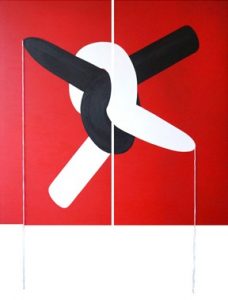
Fig. 1. Anudar y desanudar (2015). Museo Nacional Centro de Arte Reina Sofia
Pichillá and the contemporary art scene in Guatemala and Central America
In a 1999 article published in ArtNexus magazine under the title “Arte Contemporáneo en Guatemala”, Guatemalan art critic and curator Rosina Cazali describes in some detail the art scene in that country in the context of what she defines as a process of regeneration of society and its creative practices, which she describes as a contribution to the old art world:
“Y hoy, a finales de los años noventa, parece cobrar una energía inesperada. La coyuntura de un proceso de transformaciones sociales, con su consecuente voluntad de apertura y de diálogo, parece estar abriendo paso a un interesante espíritu que flota alrededor del arte y ve con entusiasmo los nuevos lenguajes contemporáneos”3Rosina Cazali, “Arte contemporáneo en Guatemala”, in ArtNexus 32, 1999. Available in: https://www.artnexus.com/es/magazines/article-magazine-artnexus/63e17e6306e458aa6cb6ec7e/32/contemporary-art-in-guatemala.
That same year, Antonio Pichillá began his formal art studies at the Escuela Nacional de Artes Plásticas Rafael Rodríguez Padilla in Guatemala4The School was founded in 1920 as the Academy of Fine Arts of Guatemala, named after its founder who was a Guatemalan painter, sculptor and engraver. Other contemporary Mayan artists were also part of this school: Marilyn Boror, Edgar Calel, Benvenuto Chavajay, Manuel Chavajay and Fernando Poyón, whose works were also part of the donation to the Reina Sofía Museum Foundation in 2020., from where he graduated in 2003. The artistic training he received at this institution was of the conventional and academic type, except for that transmitted to him by artist Roberto Cabrera, who “not only promoted that contemporary art should be based on research, conceptualism and interdisciplinarity, but also on local and indigenous art and culture”5Cecilia Fajardo-Hill, “Antonio Pichillá: PAJCH’UN Q’IIN, XAMALIL K’IN KIROONEEM SOLOONEEM“, in Artishock, April 4, 2022. Available in: https://artishockrevista.com/2022/04/04/antonio-pichilla-la-nueva-fabrica/.
This duality between traditional fine arts training and native tradition is a field of intersection that many contemporary Mayan artists inhabit and whose tension can be reflected in their works and in the relationship they establish with their communities. The demand for authenticity imposed by the artistic field contributes to sharpen these tensions, especially in the case of the subalternized peoples of Latin America. Now, why should only indigenous people respond to this condition of purity? According to Chilean researcher Cristian Vargas, because, most of the time, there is another colonizer who demands it and demands this immaculate relationship with tradition. Thus, when someone does something different from what is expected of an “authentic indigenous person”, something new or that departs from their codes (as often happens in contemporary art), they immediately become the object of suspicion: one that places them in a passive position and deprives them of the right to a more complex and diverse representativeness6Cristian Vargas, interview conducted on December 9, 2024..
In regards to the idea of the indigenous and in particular of the Mayan in Guatemala, anthropologist Maria Jacinta Xon Riquiac has coined the term mayámetro (“mayameter”), a concept that comes to be an irony of the contradictions that cohabit in the people of indigenous origin in Latin America:
“El mayámetro tiene relación directa con los procesos de racialización, que la sociedad te dice que todo esto es indígena y esto es lo otro y condiciona qué es y qué no es, que está bueno y que no. Son cuestiones sutiles y cotidianas que vista políticamente no se ve dicotómico, es un proceso que atraviesa generaciones, costumbres (…) Hay gente indígena que también determinan qué usar. Desde fuera o desde adentro hay discriminación, se compara con referentes o también se determinan las conductas en relación a si son más o menos indígenas”7Maria Jacinta Xon, “Del mayámetro al ladinómetro, Saberes Podcast”, 2023. Available in: https://www.youtube.com/watch?v=LZ58Hi4xl0o..
In this context, within the possibilities that Mayan artists have to exhibit their work, there are some non-governmental initiatives in Guatemala that have been an important part of the trajectory of Pichillá and his generation and that are mentioned by critics as relevant for the promotion of contemporary art in that country and in Central America, such as the Paiz Art Biennial and the Juannio Award8JUANNIO has been held annually since 1964, positioning itself as one of the most important artistic events in Guatemala and Latin America.. Both have contributed significantly to the international visibility of Mayan artists, through exchanges with art critics, curators and collectors, positioning themselves among the most important events in the Caribbean and Latin America.
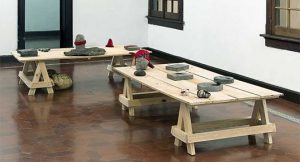
Fig. 2. GLIFOS, Arqueología contemporánea (2014). Bienal Arte Paiz.
The Paiz Art Biennial has been organized by the Paiz Foundation since 1978 and is preparing its 24th version for 2025-2026. Antonio Pichillá participated in it in 2002 (when he was still an art student), 2010 and then in the 19th version held in 2014, where he appeared as one of the 31 Guatemalan artists selected under the concept “Trans-visible” (between no longer and not yet), along with other exponents of the so-called contemporary Mayan art (Marilyn Boror, Edgar Calel, Benvenuto Chavajay, Manuel Cavajay, Fernando Poyón). Cecilia Fajardo-Hill, Venezuelan-British art historian and curator specialized in Latin American contemporary art, was part of the curatorial team of the latter show. She remembers especially when she met Pichillá’s work: “it was a really incredible installation of tied stones that the artist made for that Biennial” [translated by the author]9Cecilia Fajardo-Hill, interview conducted on January 8, 2025.. The installation to which Fajardo-Hill refers is called “Glifos (arqueología contemporánea)”. In it, Pichillá builds two wooden tables as altars to present ceremonial stones that he has moved from his community to the exhibition hall. Some of the stones are carved, others are covered with threads or scraps of cloth and show traces of soot or candle kerosene10José Luis Bolndet, “19 Bienal de Arte Paiz”, in ARTNexus 95, 2015. Available in: https://www.artnexus.com/es/magazines/article-magazine-artnexus/5d641d3790cc21cf7c0a418c/95/19-bienal-de-arte-paiz .
This first contact motivated Fajardo-Hill to include Pichillá’s work in her essays on contemporary abstraction in Latin America. In a text entitled “Abstracciones significativas” published in ArtNexus in 2014, the author argues:
“De qué manera podemos insertar la producción de arte abstracto de una zona rural en Guatemala como San Pedro de la Laguna, por artistas como Benvenuto Chavajay (Guatemala, 1978) y Manuel Antonio Pichillá (Guatemala, 1982), cuya obra dialoga con la estética específica de la zona y tradiciones culturales mayas, referencias que hasta ahora han sido excluidas de discusiones acerca de la modernidad, en una discusión “abstracta” acerca de economías capitalistas tardías”11Cecilia Fajardo-Hill, “Abstracciones significativas”, in ArtNexus 92, 2014. Available in: https://www.artnexus.com/en/magazines/article-magazine/5d6415e590cc21cf7c0a3d69/92/meaningful-abstractions.
In 2017 Pichillá won first place in the 53rd edition of the Juannio Prize for his works “Acción de un personaje q’een” and “Acción de un personaje AB’AJ”. The jury included José Falconi, Emiliando Valdés and Alexia Tala, Chilean curator who in 2021 was in charge of the selection of the XXII Paiz Art Biennial, in which the artist also participated with the work “Viento” (2020)12In relation to this work, Rosina Cazali pointed out: “In a country where weaving occupies a central place in the life of the people, artists like Antonio Pichillá, Tz’utujil and native of San Pedro La Laguna, creates a game of patterns and knots to form a gigantic loom crossed by sacred symbolism”. See “22° Bienal de Arte Paiz. Un recorrido entre el silencio y el peso de las palabras”, in Artishock, June 29 2021. Available in: https://artishockrevista.com/2021/06/29/22-bienal-arte-paiz-guatemala-resena/. As curator of this version of the Biennial and that of 2016, Tala was able to meet Pichillá and other contemporary Mayan artists13Among the Maya artists who participated in the 2021 biennial are: Marilyn Boror, Edgar Calel, Manuel Chavajay, Benvenuto Chavajay, Ángel Poyón, Fernando Poyón, Angélica Serech and Oscar Perén.. In both versions she incorporated them in the final selection because in her opinion at the time, they were the best artists in Guatemala14Alexia Tala, interview conducted on December 17, 2024.. They all studied at the art school and had an academic background, but they learned a lot from their teacher Roberto Cabrera, who investigated indigenous issues and traditions from an artistic perspective. He encouraged them to connect with each other, to reflect together and to strengthen their discourse from a situated perspective. Thus, Pichillá’s works in particular include symbols of his culture’s connection to the sacred, corn and its colors, his father’s and mother’s heritage, textiles and landscape, which he works in different formats15Idem.
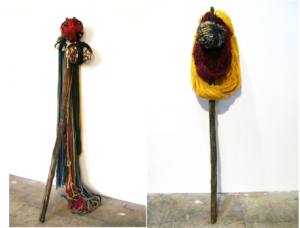
Fig. 3. Acción de un personaje q’ueen y Acción de un personaje AB’Aj (2017). PREMIO JUANNIO 2017.
Intermediate scenes, dynamics of circulation and visibility
In 2021, at the time of the donation of the works by philanthropist Mario Cader-Frech to the Queen Sofia Museum Foundation, Antonio Pichillá had had seven solo exhibitions in Guatemala since 201016In 2015 she exhibited “B’atz’ /anudar y desnudar” in Costa Rica at the Museo de Diseño y Arte Contemporáneo MADC, curated by María José Chavarría, although he was not formally represented by any art gallery. He had his residence and studio on the top of a hill on Lake Atitlán in Guatemala -where he still has them-, about four hours from Guatemala City. Tala says that, to get there, “you have to leave the city and cross on a ferry from Panajachel, in the highlands of Guatemala, to San Juan de la Laguna”17Alexia Tala, interview conducted on December 17, 2024..
One of the spaces that organized Pichillá’s last solo exhibitions before his works were incorporated for the first time into the collection of a contemporary art museum outside his country was Guatemala City’s Galería Extra, a space frequented by international curators interested in researching artists of indigenous provenance, such as Pichillá and the Benvenuto brothers and Manuel Chavajay. According to Silvia Obiols, director of the space for more than 10 years (2014), there is a special interest among collectors and museums in artists from native peoples, and that is precisely what motivated the creation of her gallery. In her own words: “Contemporary art is looking for answers and reflects on the different ways of life, questions the canon and in that context, indigenous art is presented as a practice of a different material context that is beginning to be of interest to European museums”18Silvia Obiols, interview conducted on September 17, 2024..
Since its inception, Galería Extra had to build a relationship with local artists, attending to the emerging contexts in the field of art circulation and promoting collaboration between agents so that these artists could access the international market. Pichillá’s exhibitions titled “ABUELO” and “SAQ B`EEY” -both held in 2018- were the background for the portfolio of work made by the Gallery that would reach the MNCARS team as part of the referential background for the acquisition of works by the artist. This bilingual document dated March 2019 has 52 pages where more than 30 works are presented along with brief curatorial texts by two specialists in Latin American contemporary art: the Cuban Cristina Vivez and the Venezuelan-British Cecilia Fajardo-Hill. It also includes references by the artist himself and details of his solo exhibitions, artistic recognitions and more than twenty participations in group shows.
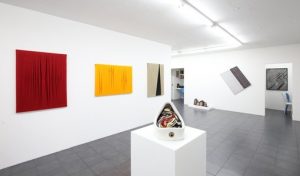
Fig. 4. Galería Extra Guatemala (2018)
One of the most extensive quotations included in this document corresponds to a text by Pichillá’s teacher, Roberto Cabrera, written for two solo exhibitions of the artist held in 2012: “B’ATZ” at the Panza Verde Gallery and “P’ICHI’YA” at the Kilómetro Gallery of the National Palace of Culture in Guatemala City. Let’s see below:
“Pichillá realiza un arte muy de este tiempo con elementos propios de su cultura, es decir candelas de cofradía, tejidos Tz`utujiles, piedras del lago, mazorcas de maíz y otros elementos de su cultura. Con ellos realiza igualmente tipos de envoltorios sagrados como los de San Martín y Ri Laj Mam en sus respectivas cofradías (…) en una madurez creativa del artista, será capaz de retomar la estética maya que le pertenece de nacimiento, más no solo desde lo manual, ya que “el arte no es una cosa manual, sino conceptual”19Roberto Cabrera, text published in Antonio Pichillá’s Dossiet, Galería Extra, 2018, p. 32..
In September 2019, Galería Extra received an international delegation of curators on a visit coordinated by Y.ES Contemporary of El Salvador, an initiative of the Robert S. Wennett and Mario Cader-Frech Foundation, which organized every year the so-called ARTS TRIPS: trips of approximately five days in which a group of curators, art critics, academics, researchers and gallery owners got to know the contemporary scene of that country20The Foundation created Y.ES Contemporary in 2015 as a nomadic non-collecting program, which focuses on supporting and increasing the visibility of contemporary artists from El Salvador through curatorial art tours, grants and workshops, exhibitions, talks, and scheduled studio visits locally and internationally.” More information at: https://www.yescontemporary.org/about. Although this program had focused on the promotion of artists from El Salvador, its influence had expanded to other Central American countries, which allowed it to reach Guatemala in 2019. The delegation that visited Galería Extra that year included the then director of the Reina Sofía Museum Foundation, Ana Tomé, and curator Alexia Tala, among other agents of international relevance. It is not possible to be certain that this visit was decisive for the incorporation of Pichillá’s works into the MNCARS Collection; however, it constitutes an important milestone for understanding the movement of Guatemala’s contemporary art scene of those years and also the approaches and searches that museums were adopting with respect to their collections.
For Fajardo-Hill, in 2020, when Mario Cader-Frech’s donation to the Museum was announced, Pichillá had a solid body of work that included not only installations and sculptures, but also a performative work that was being exhibited in different circuits21Cecilia Fajardo-Hill, interview conducted on January 8, 2025.. The artist remembers this moment as the beginning of the international circulation of his work. His 2018 exhibitions would be decisive in this sense, although in these shows he had no sale of work, diffusion in the press, nor direct contacts with collectors. The general interest did not translate then into immediate actions or agreements that would directly account for good results. As the artist says
“…yo lo tomé a la ligera y seguí trabajando, pero hoy todas esas piezas que se expusieron en 2018, nada está en Guatemala ahora, unas están en el Reina Sofía, otras en el Tate, en Denver, en el MALBA, eran obras que fueron producidas acá pero que no eran de acá, están todas afuera, y no por la gestión de una galería, porque mi relación formal con las galerías se inicia en 2023, creo que si la obra es tan buena, realmente la obra llega donde tiene que llegar en su debido momento”22Antonio Pichillá, interview conducted on December 19, 2024..
Pichillá’s vision of his work and his work is the result of an artistic training that, beyond the academic, allowed him to recognize his origin as an important part of his discursive strength, which is focused on a sustained creative work that also includes exhibition projects, dissemination and management. At the same time, the artist is aware of the relevance that currently has the link with international art agents to be able to participate in the most important fairs and biennials and thus make his work known. The legacy of his teacher Roberto Cabrera was projected in him as a way of life. In relation to the meaning of being an artist and being able to make a living from art in the Latin American context, Pichillá recalls his words, which helped him in times of difficulty: “what I don’t want from you is to be disappointed in your own work, always believe in your work, in what you do regardless of what happens, but believe in what you do”23Idem.
The exhibition that Pichillá held in 2022 at La Nueva Fábrica in Antigua Guatemala, entitled “Pajch’un Q’iin, Xamalil K’in Kirooneem Solooneem”, brought together nearly 50 works by the artist that had been previously exhibited and others that he made during the years of the pandemic. With a retrospective spirit, the exhibition presented the result of his work and career as if trying to give closure to his stage of national circulation in Guatemala. To date, this has been the last solo exhibition held in his country. It included videos, photographs, installations, paintings, sculpture and textiles and was on display for about 4 months24Cecilia Fajardo-Hill, “Antonio Pichillá: PAJCH’UN Q’IIN, XAMALIL K’IN KIROONEEM SOLOONEEM“, in Artishock, April 4, 2022. Available in: https://artishockrevista.com/2022/04/04/antonio-pichilla-la-nueva-fabrica/.
Pichillá in the MNCARS Collection
Since 2008, the Museo Centro Nacional de Arte Reina Sofía has incorporated into its lines of work the investigation of art from Latin America and has proposed to improve the representation of works in the collection, especially from some areas such as Central America and the insular Caribbean, which have had a minimal presence compared to countries such as Argentina, Peru, Brazil and Mexico25Suset Sánchez, interview conducted on November 28, 2024.. This determination of the museum to approach more silenced areas and to be able to patrimonialize new works from places less represented in its collection implied looking for alternative ways to implement its acquisition policy and focus it on strengthening institutional networks with local agents who were familiar with those artists who developed a creative work of interest but who, nevertheless, had not managed to transcend their local circulation context. Traditionally, the acquisition of works was carried out in the context of large international contemporary art fairs, where it was possible for the museum, as a public institution, to acquire works with its own funds and others from the Spanish Ministry of Culture. However, it is precisely the artists from the less represented areas who are not linked to art galleries and, therefore, are left out of these circulation circuits.
In this context, curatorial practice and field research through residency modalities, for example, have strengthened the relationship between MNCARS and the local creative scenes of the areas less represented in its collection, increasing the visibility of those artists who have remained outside the traditional circuits of contemporary arts. The creation in 2012 of the Reina Sofia Museum Foundation came to consolidate this international linkage with special emphasis on Latin America. Since then, art historians, critics and collectors with a high level of knowledge of the territorial contexts have facilitated contact with local circuits by accompanying the museum’s team in field explorations. In relation to artists from Central America, such as Nicaragua, Panama, Honduras, El Salvador and Guatemala, a specific line of work was opened with the aim of strengthening research in that area, which also considers artists from the transition or entry period to abstract painting. The 2020 donation was a breakthrough for the museum’s collection and for the research project that was being carried out on the artistic movements that have emerged in Latin America since the 1960s, especially on Mesoamerican art and the creation of contemporary Mayan artists. Likewise, the creation of the service for the “Latin American Art” collection in 2023 has been, according to its coordinator, Suset Sanchez, the concrete result of all this field research and residencies that allow understanding the complete structure of the collection, its orientation, the discourses and contexts that support it and at the same time visualize the geographical and temporal spaces that have been omitted or silenced26Idem.
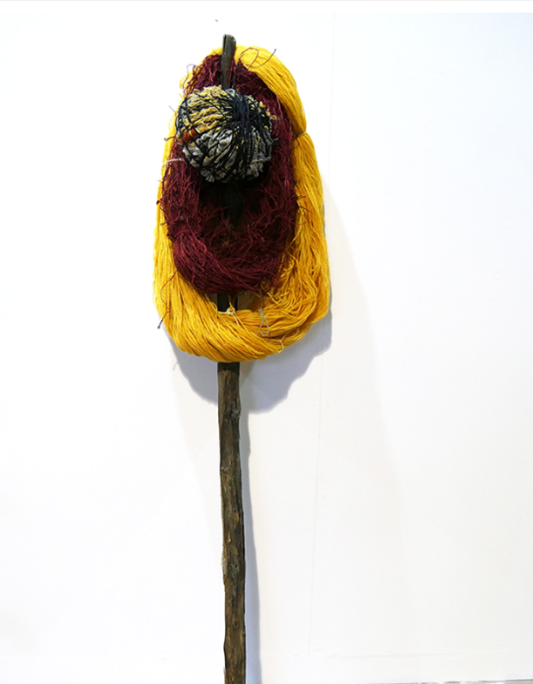
The works by Pichillá that entered through Mario Cader-Frech’s donation to the MNCARS collection were three: “Anudar y desanudar”, made in 2015, “Quipo” and “Abuelo”, both from 2016.These works were part of a body of work by contemporary Mayan and Salvadoran artists that were grouped under the classification of “Arte Mesoamericano”, and among them are Marilyn Boror, Benvenuto Chavajay and Manuel Chavajay, Ángel and Fernando Poyón.
It could be debatable, but several authors have noted how certain works can lose a degree of their political force once they enter museum collections27Hans Belting analyzes how the function of the museum can affect the perception and impact of works of art, suggesting that their inclusion in an institutional space can decontextualize their original message: “The museum not only preserves and exhibits, but also transforms the meaning of works of art, stripping them of their original context and, in many cases, their critical capacity.” See Hans Belting, El fin del museo. Una conversación con Hans Ulrich Obrist, Adriana Hidalgo Editora, Buenos Aires, 2007.. Following this line of thought, it is possible to speculate that reactivating that political force would depend, in part, on how the works are exhibited, how often, in what context and under what historical circumstances, as well as on the dialogues they can establish with other works and with the artist. In the case of the works by Pichillá donated to MNCARS, it is important to consider that they were part of the museographic proposal that the museum inaugurated in 2021, which reflected an institutional effort to transfer the curatorial reflections around them to the administrative structure that was taking charge of the institution’s new acquisitions. This was also intended to avoid the tendency of the collections to fetishize the works and turn them into static objects, putting them into circulation to provoke a link with the public that would unleash permanent reflections, re-readings and new processes of legitimization. Along these lines, the rearrangement of the MNCARS Permanent Collection under the title: “VASOS COMUNICANTES Colección 1881 – 2021”
“…propone una nueva presentación que no es la sucesión cronológica de los acontecimientos y obras, sino las relaciones y genealogías que desde el presente podemos tejer y desvelar. Se proponen, de este modo, ocho episodios temáticos que se abren a temporalidades flexibles y a enfoques interdisciplinares, y que pueden vincularse entre sí generando a su vez nuevos relatos”28Museo Nacional Centro de Arte Reina Sofia, “Vasos Comunicantes Colección 1881 – 2021.” Available in: https://www.museoreinasofia.es/publicaciones/vasos-comunicantes-coleccion-1881-2021 .
One of the thematic episodes of this exhibition was Dispositivo 92 ¿Puede la historia ser rebobinada? (“92 Device Can history be rewound?”). Here the discourse was spun as a counter-narrative to the celebration of ’92 as the fifth centennial of the “discovery of America,” articulating a critical reading through voices that had been silenced by official narratives, which was presented as a response or a historical version proper to Eurocentric modernity. Regarding this new presentation, the museum documents state that the objective had been to reflect a more critical view of 20th century art, reorganizing the collection and focusing it on narratives and experiences that spoke of the present through the common past, and to question the traditional views of modernity through feminist, decolonial and ecological approaches that showed a more heterogeneous and complex context29Idem.
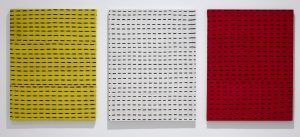
Fig. 5. ABUELOS (2016). DO03600, Museo Nacional Centro de Arte Reina Sofia
Of the three works by Pichillá donated to MNCARS, two – “Abuelo” and “Quipu” – were put on display alongside other works by Maya artists such as Marilyn Boror, Edgar Calel, Benvenuto Chavajay and the brothers Ángel and Fernando Poyón. “Quipu” was subsequently removed30According to the Museum’s work movement register, “Quipu” entered the warehouse in March 2023. as part of a rotation of funds; instead, the work ‘Grandfather’ remains in room 002.17 of the Sabatini Building. Although for some critics, such as Alexia Tala, the mounting of these works only deepened the colonial gap by leaving all the Mayan artists together in the same room, without the possibility of dialoguing with other works and other discourses -as happened, for example, in the case of the Tate’s proposal in England-31Alexia Tala, interview conducted on December 17, 2024., for Pichillá himself, the decision of how his works are exhibited in the museum corresponds to the institution. In addition, the artist assumes without major conflict that his incidence in this exhibition is not the same as in his individual exhibitions, where he arranges the works in the space according to his own artistic criteria. At this point it should be noted that Pichillá’s works have not only strengthened certain plastic expressions that are part of his philosophy of life, work and understanding of the world, but also seek a presence in the space that allows them to dialogue. In this sense, there is an artist’s awareness of the space and the installation that make up the discourse of an exhibition. That is why in his exhibitions the works are not placed in a linear fashion. As the artist says:
“…siempre trato de que ciertas obras estén como un poco más arriba y otras que ocupen el piso, que estén contado entre el cielo y la tierra, el inframundo. En mi trabajo, cuando se hace una exposición, yo uso mucho las esquinas, algo que casi no lo usan, o el mismo piso, por ejemplo, las obras que yo trabajo con piedras, no uso pedestal, no uso soporte, me interesa que la piedra esté directamente con el piso, y se conectan con la naturaleza”32Antonio Pichillá, interview conducted on December 19, 2024..
Since joining the MNCARS collection, Antonio Pichillá’s international visibility has grown, which has translated, for example, into the interest of other institutions in acquiring his works, especially those produced between 2014 and 2020. In addition to the Museo Nacional Centro de Arte Reina Sofía, the art space Il Posto incorporated three works by the artist to its collection in 2021: two entitled “Knot” from 2016 and “Fuego” from 2020. In addition, the TATE London has “Grandfather” from 2017, “Grandmother” from 2018, “Road” from 2018 and “Kukulkan” from 2017. And finally the MALBA in 2023 incorporates “Grandfather” from 2014 to its collection.
The series “Grandfather” (2014 to 2020) and “Knot” (2010 to 2021) are the ones that have been of greatest interest to curators and collectors. Both are proposals that Pichillá has been developing for several years, something that also shows a prolonged reflection on certain concepts and their materialization in different artistic proposals. They are emblematic works that embody important themes for the artist through different material and chromatic codes, using abstraction as an artistic language that distances itself from Western modernity to the extent that it is no longer posed within the framework of the well-known opposition between “abstraction” and “representation”, opening up a critical space of thought for Latin America. In the words of Cecilia Fajardo-Hill,
“se cuestiona la narrativa institucional del arte abstracto como una búsqueda monocultural y monolítica de “pureza” artística para abarcar una noción de múltiples modernidades transculturales, donde la principal cualidad del arte abstracto es su apertura, y que es crítico, híbrido, parcial, multidireccional, pluralista e intenta descentrar las convenciones de la representación visual”33Cecilia Fajardo-Hill, “Abstracciones significativas”, in ArtNexus 92, 2014. Available in: https://www.artnexus.com/en/magazines/article-magazine/5d6415e590cc21cf7c0a3d69/92/meaningful-abstractions..
Although the possibility of entering the collection of a contemporary art museum outside Guatemala could be seen in itself as an achievement, for Pichillá this milestone awakened the need to activate his relationship with the galleries that, in his own words, mobilize his work and allow him to hold solo exhibitions with more frequency and validity. Leaving the autonomous work and being represented by these agents has allowed her, on the other hand, to access the circuits of the most important international fairs and biennials, delegating a large part of the administrative management of these processes.
In 2023, the Elvira Moreno Gallery of Colombia was the first to represent Pichillá, also holding a solo exhibition of the artist, called “Ximoneem K’in Soloneem” (“Knotting and Unknotting”). The Luciana Brito Gallery of Sao Paulo and Portas Vilaseca Gallery of Rio de Janeiro in Brazil and Elizabeth Xi Bauer of London, who exhibited the show entitled “In Front of the Lake” in 2023, joined the group. And for this year 2025, Pichillá is preparing his exhibition at ARCO Madrid with Memoria Gallery. Thus, in less than two years, the artist has been formally linked with 5 galleries, which has allowed him to mobilize his creations -especially in those countries where they have acquired his work- and also to participate in fairs and biennials. This shows the importance of the international circulation of work for artistic validation, especially for an artist living in an isolated region. As Pichillá says: “I don’t live in London, I don’t live in New York, I live in Guatemala, in Central America and I don’t live in Guatemala City, I live 4 hours away, in a village, and the realities are different, so I am aware of that”34Antonio Pichillá, interview conducted on December 19, 2024..
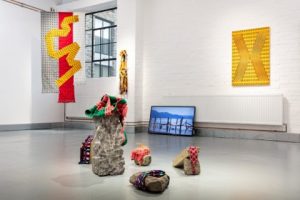
Fig. 6. Enfrente del Lago (2023). Galería Elizabeth Xi Bauer
Current museological perspectives on contemporary indigenous artwork
Since the second half of the 20th century, artists have ceded part of their protagonism to other agents of the art world. The figure of the curator, for example, acquires special relevance when exhibitions are installed as the generators of artistic discourses and is essential for the study of art history, without neglecting the relationship of the work with the physical and discursive spaces of its exhibition, which have had to be transformed to respond to these challenges35Ana Maria Guash, El arte del s. XX en sus exposiciones. 1945 – 2007, Ediciones del Serbal, España, 2009, p. 270..
This displacement has been approached from the perspective of museology by Claire Bishop, who accounts for the passage from a nineteenth-century model of the museum as an institution of elite culture to one that situates it as a populist temple of leisure and entertainment. Between these extremes, Bishop situates certain museological practices that have incorporated an art historical method in which contemporaneity is positioned as a dialectical discursive category that exposes and confronts arguments to rethink its relationship with history and approach the social and political urgencies that seek to alter the current relativistic pluralism where any belief is valid36Claire Bishop, Radical Museology, or, ¿What’s ‘Contemporary’ in Museums of Contemporary Art?, Koenig Books, London, 2013, p. 9.. One of the cases addressed by this author is precisely that of the Museo Nacional Centro de Arte Reina Sofía, as a space where practices have been developed that have proposed to connect the artistic with a broader field of visual experience and where the viewer is presented with arguments and positions that can be questioned. Bishop uses the concept of “constellation” as part of the curatorial writing, through which the museum can even question the categorization of the work of art as “documentation” and thereby validate the multiple readings that can occur in the exhibition context, as in the case of the current exhibition of the MNCARS collection.
MNCARS continually revises its categories and questions the taxonomies it uses. The reformulation of its permanent collection in 2021, as well as the one now being prepared for the year 2026, aims to make room for the exhibition of new acquisitions, especially those that have been the subject of research. For the museum, the presence of works like those by Pichillá and other contemporary Mayan artists in its permanent exhibition responds to a juncture in which there has been greater representation of Latin American artists but in which, nevertheless, it is still a novelty to find voices and aesthetic proposals of contemporary artists who are part of indigenous traditions or cosmogonies that have not been exhibited in Spain. That is why it has been necessary to explain in this tour certain conditioning factors of the social and political contexts where these aesthetic proposals emerge.
This first museographic proposal we have analyzed, however, is already being revised to give way to a new reordering that will be inaugurated in March 202637Suset Sánchez, interview conducted on November 28, 2024. and where it is proposed to move towards a distribution that manages to trace more linked stories, more transversal, and where artists from different Latin American contexts are in dialogue simultaneously with Spanish artists and artists from other latitudes. In this way, it is also intended to break away from watertight compartments and specific case studies to talk in a more fluid way about the interrelation of diverse practices, which will surely lead to the exhibition of new works from other funds.
What could happen then with the works donated to MNCARS in 2021? Museums must be alert to the phagocytic effect that the art system and institutions can have on their collections, even more so when faced with the colonialist threat that prevents the visibility of certain objects and the active transfer that enables the consolidation of contemporary artistic practices. For MNCARS, especially as a public institution, it is important to sustain a continuous epistemological critique that allows them to know how to operate, how to treat and, above all, how to provide feedback to the communities of origin of the artists that are part of its collection. At the same time, the institution must be very conscious of avoiding capitalist pressures and profitability, while also respecting the times, procedures and diversity of working methodologies of the artists.
It is worth asking, then, if it is the artists who are questioning the traditional hegemonic discourses by joining museum collections, thus displacing the traditional canon, or if it is the art institutions that have induced artists to adopt certain concepts in order to become part of the system and thus legitimize a contemporary discourse that appears to be diverse, inclusive or anti-hegemonic. For Beatriz Robledo, deputy director of the Museo de America in Madrid, museums are at the center of this debate and have become spaces of political action where the shaping of the image of the world we want is at stake. The reorganization of the system of relations between cultures and societies is an uncomfortable process typical of the postcolonial era that has made it possible to question the world order that museums themselves once helped to legitimize. However, today it seems that the incorporation of artworks from indigenous horizons only seems to be forcing artists to go through the archetypal models of what is or is not art, forcing them to enter into a dynamic that is not their own and risking their creative freedom38Beatriz Robledo, interview conducted on October 15, 2024..
On the other hand, for Cristian Vargas, researcher and curator of Chilean indigenous art, the issue has more to do with the strategies museums have implemented to address the colonial issue and its legacies. One of them is the acquisition of works by contemporary indigenous artists understood as a gesture of reparation that stems from a review of their own collections and the identification of certain gaps in a sort of “critical museology of their own institution”. Another line of work can be a deeper decolonizing policy that does not only respond to the revision of the collections, but rather to a will to incorporate new visions to the internal policies of the institution and that also promotes the integration of indigenous people in its work teams, since talking about indigenous contemporary art implies dealing with living artists and contemplating them for registration and exhibition proposals39Cristian Vargas, interview conducted on December 9, 2024..
Working with works that come from non-Western horizons requires museums to rethink their procedures and mechanisms of management, acquisition, conservation and, of course, registration and cataloging, so that they can move towards structural changes that allow them to treat these works with material and immaterial respect40In this context it is worth mentioning the case of the custody by the Tate Museum in London of the ceremonial installation by Edgar Calel, one of the contemporary Mayan artists of the generation of Pichillá, this agreement modifies the administrative language of the institution from which the collection is organized, and which also sets a precedent in the form of relationship between museums and works that come from other cosmogonies, and where the material and ritual value of the work that will remain in custody for 13 years is recognized. Although in the traditional and modern European language of these institutions it is a deposit, the legal texts include how the work is administered and how it must be treated within the museum space, considering the traditions from which these artists come, which from every point of view is far from how a canvas of a painter trained in a European academic tradition is treated.. In this regard, it is essential to transcend the purely aesthetic language and incorporate into the record of the works the knowledge linked to the manufacturing processes, the relationship with the landscape and so many other elements that have been related to the crafts and therefore have been excluded, even in the case of these works that, being contemporary art, coexist with that symbolic universe that often does not recognize the limits imposed by academic definitions.
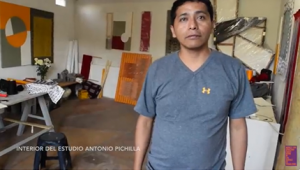
Fig. 7. Estudio de Antonio Pichillá, San Pedro La Laguna, Lago Atitlán, Guatemala
Final words
The case of Pichillá as part of the Central American contemporary art scene shows a shift in relation to the importance of international circulation for artistic validation, since, although it does not deny it completely, it does modify the role of the agents and especially that of the artist himself in the development of the exhibitions and the links that take place in the contemporary art field. To sustain the origin, understood not only as the place where the artist lives, but rather as the symbolic charge of coming from a Mayan culture, becomes the strength of that discourse that is projected in his work and that finally opens and modifies the art system to make a place for himself.
Beyond his works, Pichillá’s position in the world has challenged the art system and with it also the museums as institutions, which have had to rethink the themes they address, review their collections and also the hierarchies imposed by the forms of registration and the typologies they use, where the biases of a hegemonic gaze still exist.
Bibliography
Claire Bishop, Radical Museology, Koening Books, London, 2013.
José Luis Bolndet, “19 Bienal de Arte Paiz”, in ARTNexus 95, 2015. Available in: https://www.artnexus.com/es/magazines/article-magazine-artnexus/5d641d3790cc21cf7c0a418c/95/19-bienal-de-arte-paiz
Rosina Cazali, “22° Bienal de Arte Paiz. Un recorrido entre el silencio y el peso de las palabras”, in Artishock, June 29 2021. Available in: https://artishockrevista.com/2021/06/29/22-bienal-arte-paiz-guatemala-resena/
Rosina Cazali, “Arte contemporáneo en Guatemala”, in ArtNexus 32, 1999. Available in: https://www.artnexus.com/es/magazines/article-magazine-artnexus/63e17e6306e458aa6cb6ec7e/32/contemporary-art-in-guatemala
Cecilia Fajardo-Hill, “Antonio Pichillá: PAJCH’UN Q’IIN, XAMALIL K’IN KIROONEEM SOLOONEEM“, in Artishock, April 4, 2022. Available in: https://artishockrevista.com/2022/04/04/antonio-pichilla-la-nueva-fabrica/
Cecilia Fajardo-Hill, “Abstracciones significativas”, in ArtNexus 92, 2014. Available in: https://www.artnexus.com/en/magazines/article-magazine/5d6415e590cc21cf7c0a3d69/92/meaningful-abstractions.
Galería Extra, Antonio Pichillá’s Dossier, 2018.
Ana Maria Guasch, El arte del s. XX en sus exposiciones. 1945 – 2007, Ediciones del Serbal, España, 2009.
Museo Nacional Centro de Arte Reina Sofia, “Vasos Comunicantes Colección 1881 – 2021.” Available in: https://www.museoreinasofia.es/publicaciones/vasos-comunicantes-coleccion-1881-2021
Maria Jacinta Xon, “Del mayámetro al ladinómetro, Saberes Podcast”, 2023. Available in: https://www.youtube.com/watch?v=LZ58Hi4xl0o.
Appendices
Solo exhibitions by Antonio Pichillá

Acquisition of works by Antonio Pichillá in international museums



