

This thing of darkness I / acknowledge mine.
W.S.
“What has caused controversy,” said a young Chilean astronomer when asked on television about comet 3I/Atlas13I/ATLAS is a comet from outside our solar system, detected in the Chilean town of Río Hurtado in June 2025 during routine monitoring of objects near Earth. On social media and in circles linked to conspiracy theories, there were talks about the possibility that it was an artificial artifact. In other words, there was speculation about its alien origin., “is that we don’t understand it.” The statement was followed by silence and then an explanation: “Because it is a distant object.” And although it may seem insufficient, that reason reveals its own logic: what is incomprehensible is not what is unattainable, but what does not yet fall within our system of understanding. Even though we have instruments and machines capable of estimating probabilities, human knowledge has its own pace. And it is subject to bias.
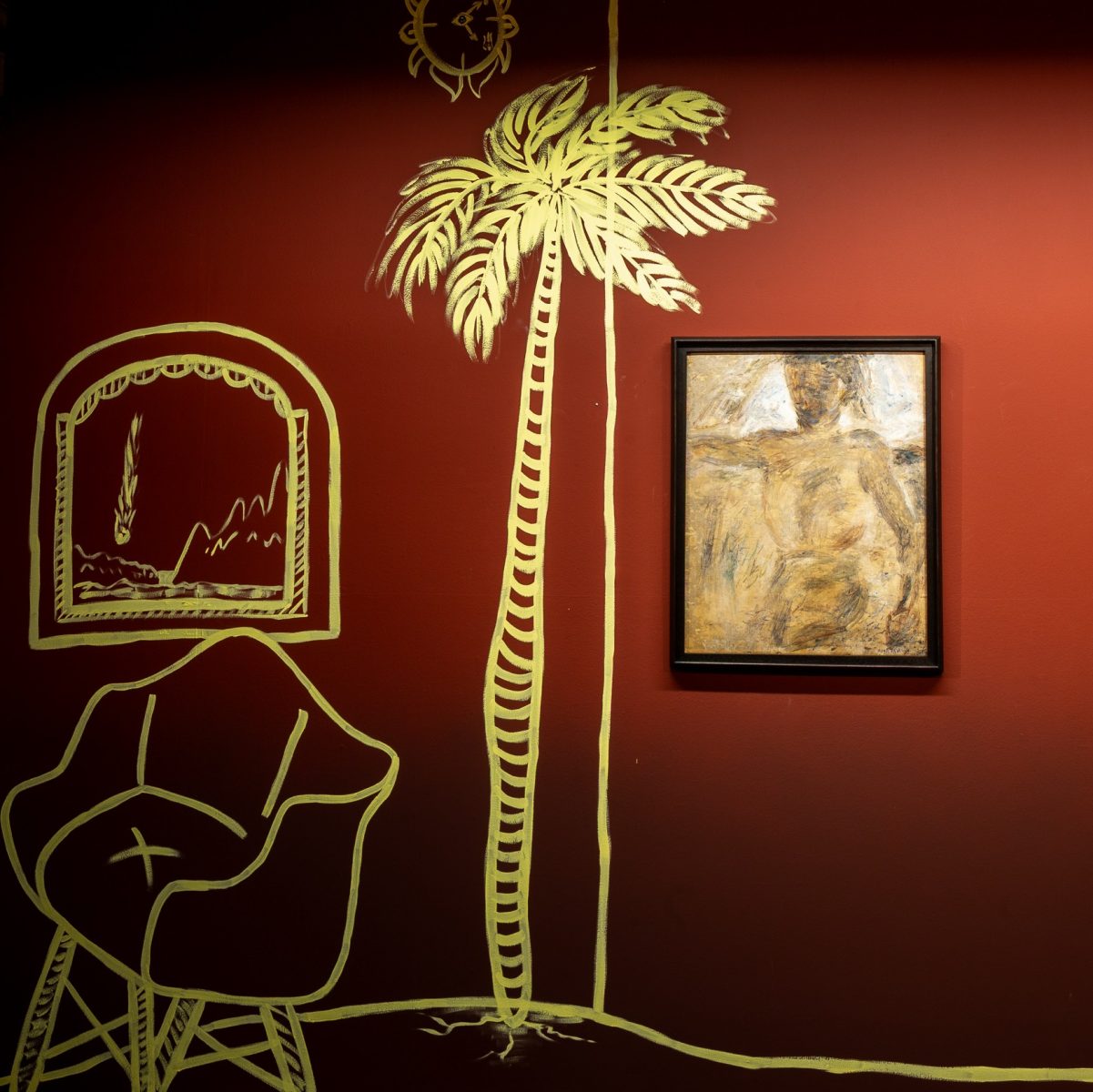
If 3I/Atlas, that solitary traveling rock surrounded by gas and dust, seemed strange even to science, it was not only because it came from another system, but because it was unlike anything we had ever seen before. Which, in turn, reflects how limited our ability to deal with the strange really is. In the Temporary museum, curated by Sergio Parra in the exhibition hall of Il Posto, in Vitacura, the mysterious interstellar comet appears twice on the walls painted by Wiki Pirela. And it is no coincidence that she was the one who painted them: the Venezuelan artist, based in Chile, is also an oddity within our own artistic system.
In just a few years, Wiki has enriched the scene with references to her childhood in a working-class neighborhood of Caracas and, above all, has elevated, through her practice, enjoyment, joy, and affection as central themes of conceptual art in a system dominated by often dispassionate discourses. Her freehand strokes, drawn directly on the walls of this museum, move with ease and grace across the horizon, bringing out the elements typical of any exhibition space, even though this museum is crooked and irregular. And, for that very reason, alive.
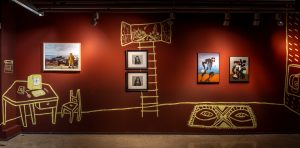
Fig. 1. Interventions by Wiki Pirela en the Museo Temporal exhibition at Il Posto, 2026
Wiki depicted a door and its peephole, painted an enigmatic wallpaper with a floral pattern that appears to have wings, drew baseboards and crown moldings, opened a window through which we see the landscape, but also the 3I/Atlas—while installing spotlights and surveillance cameras. She added complexity to the building-institution-museum, showing us its domestic dimension by including a calendar with a cross marked on the last Thursday of the month and key hooks. She disrupted the room’s interior with a vigilant sun and a tropical palm tree. Then she painted a beautiful carpet that looks at us and left a pair of shoes in a corner, near a small table where an electric kettle is about to short-circuit. By allowing flames to break in, far from the fire hose, she brought disaster, and by covering the cracks in the walls, she exposed it as a precarious place. The museum presents itself to us in crisis. Unstable, insufficient. We see this (modern?) institution, full of setbacks and contradictions, discredited as a machine for selection and framing.
Il Posto’s Temporary museum opens with Origin (2021), a canvas by Wynnie Mynerva. Her oil painting provides a conceptual introduction to the exhibition and to the words that will describe it, drawing it from its beginnings towards desire. We see penises trying to penetrate anuses and vaginas, we see breasts, folds, and hands squeezing, and between them, various bodily fluids. At this threshold, life, death, and sex come together, all mixed up in a visual orgy. Despite being frontal and explicit, Wynnie’s painting delicately employs transparency and creates an abysmal depth. In her imagination, there is never a single body, but multiple overflows, intersections, and contaminations, which seems to warn us that nothing in this museum will be in its pure state either.
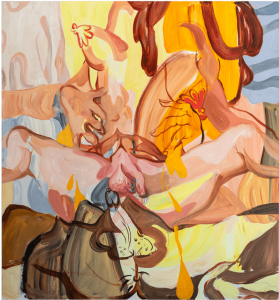
Fig. 2. Wynnie Mynerva, Origin, 2021
In fact, if we look at the artist’s own biography, we see that displacements mark it: in the 1970s, her parents migrated from the Andes to the sand flats of Lima. There, they built a house made of mats alongside a few other families who, in a short time, “multiplied like viruses,” says writer Gabriela Wiener. Today, Villa El Salvador is a city of half a million residents, built “thanks to the ayllu and community organization on the same lands that were ravaged by colonial violence.” According to Wiener, Wynnie moves “through fortress Europe” with that same expansive, diasporic energy2Wiener, Gabriela (2025). Wynnie Minerva. “Encontré un poder en ser el terror de la gente”. In Pikara Magazine. [Online] Available in: https://www.pikaramagazine.cominicio2025/04/encontre-un-poderinicio-en-ser-el-terror-de-la-gente/. And from the outset of the Temporary museum, she proposes a counterpoint: the other side.
Next to Wynnie Mynerva’s painting is the equally monumental and unsettling Neuquén 1984 (2018) by Natalia Babarovic, who works with oil and spray paint on a copy of a work by Italian maestro Guido Reni. Instead of bowing to the tradition of classicism, Natalia resorts to irreverence and blurs the boundaries between “high” and “low” culture, merging different pictorial styles into a large, stained, hybrid, and beautiful piece. Not only is the canvas altered, but also the elaborate frame made of fleshy leaves carved in wood, which ultimately disrupts everything: the motif and the painting’s scene. Her work, therefore, is an accomplice to the provocation directed at the museum.
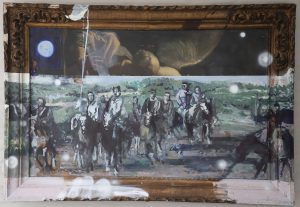
Fig. 3. Natalia Babarovic, Neuquén 1984, 2018
Babarovic’s gaze, which emerged at the end of the dictatorship in Chile, collects — as Diego Maureira points out — “the retina of a painting that is shipwrecked in the southern hemisphere of America”3Maureira, Diego (2020). Transmisiones en directo colapsadas por luz artificial. In Artishock [Online] Available in: https://artishockrevista.com/2020/11/26/natalia-babarovic-d21/. And from this rugged shore, she chooses to represent, in this case, another form of organization. The work portrays a Mapuche community celebrating a nguillatún, a prayer ceremony in which balance, well-being, good harvests, and abundance are requested from the four gods of Wenu mapu (“Land Above”) after a harsh winter marked by more than two weeks of snow. Babarovic superimposes Guido Reni’s mythological and laconic motif onto a local, pagan scene that, in the context of this temporary museum, takes on even greater significance.
In Spanish, synonyms for the word “temporal” —which appears in the original title of this exhibition: Museo temporal—, refer to something temporary, transitory, and fleeting, but also, in meteorological terms, it refers to a storm. Following Maureira’s metaphor, Babarovic’s work emerges from the remains of a shipwreck and, like the other pieces displayed here, conjures ancient knowledge and creatively rises against the tools of oppressive power. It represents a natural force with destructive capacity.
If the territorial conquest to which our continent was subjected was only part of a larger plan involving spiritual domination, then, for the colonial forces, control meant implementing a religious system. And if I have previously used the verb conjure to describe what occurs among the works that make up this Temporary museum, it is because I believe that, taken together, they reveal beliefs that come from other traditions. I am referring to witchcraft, pagan knowledge, and American cosmogonies that have been attempted to be made invisible for centuries. But here they are shown as particular wills: stubborn, obstinate, resistant.
Faced with this, Paula Anguita brings an illuminating game to the museum. In her series Salomé I-VIII (2021), she works with a double surface: one visible and one invisible. The eight rectangular devices are displayed on the last wall of the Temporary museum, at average human height, and require viewers to approach them with their phone cameras. Only when the flash is activated does the invisible image become visible. And what we see in these dark mirrors is a dance: the step-by-step movements of a disheveled woman, rehearsing different poses in a petticoat, indoors. Paula Anguita’s Salomé exposes dance as a way of resisting the social order that needs to tame the unruly.
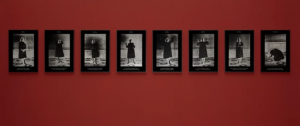
Fig. 4. Paulla Anguita, Salomé I a VIII, 2021
Like a flash of lightning, the artificial, fleeting light allows us to enter the intimate space of an anonymous patient at the neurological school run by Jean-Martin Charcot, reminiscent of the infamous photographs of Louise-Auguste Gleizes, taken. At the same time, she was confined to the Salpêtrière Hospital in Paris. However, Paula Anguita does not fall into the compassionate gaze that has already been cast upon them: she accompanies the portraits of the lonely dancer with excerpts from the poem Lebensgebet (1882) by the Russian writer and psychoanalyst Lou Andreas-Salomé4One of the verses reads: Let your light ignite my spirit, and that is literally what the work does when activated., author of essential essays on narcissism and female sexuality. In other words, she imbues them with a new strength and freedom, granting them, centuries later, a specific autonomy5After all, Salomé was the first woman accepted into the psychoanalytic circle in Vienna, Freud’s peer, forming an intellectual trio with German philosopher Paul Ree and Friedrich Nietzsche, as well as being Rainer Maria Rilke’s lover.
If nineteenth-century science taught us to look, under male medical authority, at female patients—often drugged and exhibited as evidence—Paula denounces the cruel strategies of that gaze to which they fell victim. Here I return to the previous problem: we know that power needs to produce visible bodies that confirm its categories, and the works in the Temporary museum encourage us to question the surfaces of inscription onto which the fears, fantasies, and theories that have perpetuated these closed systems of categorization are projected.
Walter Benjamin once said that no document of civilization is not also a document of barbarism, and the same could be said of the concept of the museum. But the works that make up this museum, in particular, openly deal with the violence perpetrated by states, nations, and institutions against their authors and communities. And they attempt, through art, to make amends. In this sense, the constellation of strange works is mirrored and aligned on the same horizon.
We see Christian Vinck’s delicate paintings pass by like a shooting star, and the museum grants them their own resting time on a wall, all to themselves. Surrounded by absolute darkness but highlighted by an artificial spotlight, the artist’s delicate brushstrokes reveal, on their surfaces, emotional links between the spaces, gaps, and people represented. Then, all the pieces orbit around a sun—a central work in the middle of the room. I am referring to Mimesis of mimesis (2016), by Naufus Ramírez-Figueroa: a performance that arose from questions the Guatemalan artist asked himself about the duration and persistence of social and individual bodies.
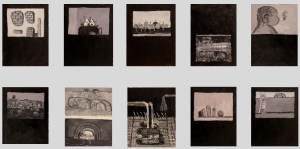
Fig. 5. Christian Vinck, Guston Revisitado, colección blanco y negro, 2014
More than a decade ago, Naufus chose to perform at the KIT (formerly known as the Royal Tropical Institute) in Amsterdam, created to “study the tropics and promote trade and industry in the Dutch colonial territories”6This is stated by the institution itself on its website. For more information on this, see the Brief History of KIT, which is available online: https://www.kit.nl/about-us/our-history, that is, to promote the exploitation of “tropical” products. In this building brimming with signs of imperialist opulence, he installed himself, naked, on a plinth of mattresses, cushions, and foam sheets, tied to them with ropes as if they were all part of the same armchair. He did so in a room of marble, stone, and fine wood which, like the Temporary museum, has walls with ornamental moldings, rosettes, dentil cornices, and, of course, an elaborate wallpaper that gives it a somewhat old-fashioned look.
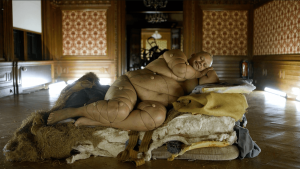
Fig. 6. Naufus Ramírez-Figueroa, Mímesis de mímesis, 2016
By exposing himself, Naufus shows us how the museum can be an epistemological machine of colonialism and, in that marbled, ornamented and neo-Renaissance interior where imperial knowledge about colonized bodies and territories was once celebrated, he chooses to sleep. But this passive stance is merely a decoy. By becoming an object, he breathes and shatters expectations of what the imperialist mindset considers valuable, docile, and worthy of display. And although he smiles, he does so under an enormous lamp made of glass teardrops. Thus, his placid expression reveals itself to be tremendously sinister.
Incidentally, his and the other bodies in the Temporary museum are far from ideal. Overflowing, joyful, and rebellious, they soak each other up as they resort to pleasure and enjoyment. “Even though the body has gone through frustrating processes, laughter is our ultimate victory,” Wynnie Mynerva said recently in an interview. In fact, humor and tenderness give rise to unexpected alliances between the pieces in this museum, filling the cracks: it is through them that both the beautiful and the terrible come through.
Among the organic forms that Fernanda Laguna paints in her Éxodo de mi mente hacia un cuadro marrón y azul (“Exodus from My Mind to a Brown and Blue Painting”) (2013) and Composición con cerveza (“Composition with Beer”) (2012), there is a nod to the gestures with which her compatriot Lucio Fontana began the so-called Serie de los tajos (“Slit Series”) in 1958. But those surgical incisions that Fernanda inflicts on her canvases resonate not only with the radical practice of cutting, but also reveal the performative decision to interrupt: the landscape, tradition, everything. The slashes are suspensions of meaning and windows through which the wall of the Temporary museum is exposed. These gaps serve the same purpose as the vibrant colors with which Ana Segovia represents an embrace on his canvas: to disconcert and disrupt continuity, proposing detours.
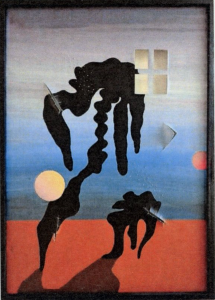
Fig. 7. Fernanda Laguna, Éxodo de mi mente hacia un cuadro marrón y azul, 2013
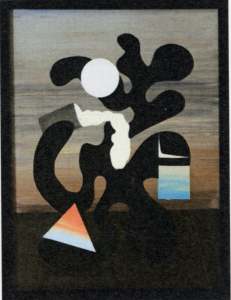
Fig. 8. Fernanda Laguna, Composición con cerveza, 2012
“Color is affective”7Olivera, María (2024). Ana Segovia: Perseguir el movimiento. In La Tempestad [Online] Available in: https://www.latempestad.mx/ana-segovia-visita-de-estudio, Ana has said, and in his case, it is also transgressive. Looking at the strange touching of hands, clothes, and torsos he paints in his Composición 1 (“Composition 1”) (2024), I think that perhaps, more than bodies, what has been conjured up in this museum are tempests. Violent disturbances of great magnitude: severe and dangerous works, capable of disrupting the above and below, and ruining any attempt to establish hierarchy. We know that a storm has the value of being ambiguous and creates undefined or chaotic spaces in which sea and sky merge8I am thinking here of J.M.W. Turner who, in the winter of 1842, set sail from the port of Harwich aboard the paddle steamer Ariel in the midst of a snowstorm. Turner asked the ship’s sailors to tie him to the mast so that he could watch the storm. In Snow Storm (1842), the almost abstract brushstrokes with which he depicted the snow and waves are a record of his suffering during four hours at the mercy of the storm., and in that sense, I would like to briefly mention Shakespeare’s dramatic testament, which begins with a storm and a shipwreck.
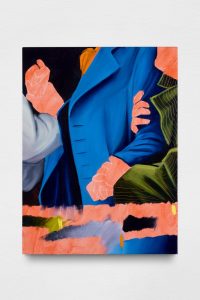
Fig. 9. Ana Segovia, Composición 1, 2024
Although The Tempest (1611) has been read as a colonial drama because it establishes the power of European man in an unknown territory, it is also full of subversive power. Of magic, of repentance, and of the healing power of affection. After all, Prospero renounces control of the seas—control of the self—when he understands that the storm is a projection of his inner turmoil. And here I think of how well this play dialogues with Armando Reverón’s painting on display in the Temporary museum: one of the last canvases the Venezuelan painted before he died in 1954, which not only shares a certain aura of repentance with Prospero, but also surrounds us with the universal loneliness of the castaway.
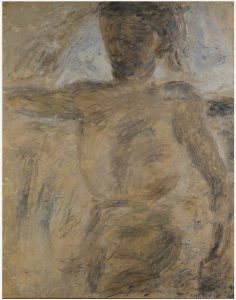
Fig. 10. Armando Reverón, Sin título, c. 1950
Just as storms can destroy, they can also lead people and communities to discover new dimensions of themselves. And to action. As researcher Fiammetta Dionisio says, tempest can mean revolution9Fiammetta Dionisio, “Shakespeare’s Imperfect Art of Navigation: Controlling the Forces of the Sea in The Tempest (1611)”, Représentations dans le monde anglophone [Online] Available in: https://publications-prairial.fr/representations/index.php?id=9,1. In this sense, there are no still works in the Temporary museum; they are all stirring something up or lying in wait. However immobile they may seem, Marinello’s portraits of Pedro Lemebel contain a subversive, explosive force10Sergio Parra lovingly placed them climbing a staircase that leads to an urban landscape similar to that of Santiago—a city that Lemebel so skillfully unraveled in his chronicles and that Wiki Pirela updated, painting an apocalyptic scene alongside 3I/Atlas,.. One only has to try to hold the gaze of these two Molotov portraits to realize that there is no escaping the impact of the gaze of the beautiful mare, portrayed twice in the same sitting position, in homage to Frida Kahlo.
The same can be said of Edgar Calel’s contemplative figure in his Ru Kuxlab’el ri B’alam / Suspiro de jaguar (“Jaguar’s Sigh”) (2025), a photograph that, at first glance, questions territory, identity, and belonging. But then it delves into other types of fragilities. According to María Carri, different indigenous people, with their multiple identities and particular demands, are asked to share a wisdom (always ancestral) that offers solutions to imposed problems. “This dangerous recurring call to the knowledge of the past or to the ‘imagination of new worlds’ in the future evades the responsibility of facing up to the present”11Carri, María (2023). B’alab’äj (Jaguar Stone) Piedra del Jaguar. In Artishock [Online] Available in: https://artishockrevista.com/2023/07/28/edgar-calel-balabaj-jaguar-stone/. And in that sense, Edgar honors and frees himself from the prison of meanings that is imposed on him for being an indigenous artist and literally turns his back on the museum.
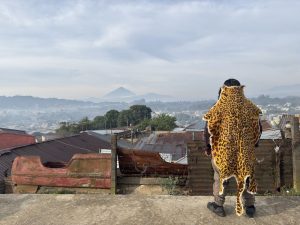
Fig. 11. Edgar Calel, Ru Kuxlab’el ri B’alam / Suspiro de jaguar, 2025
Although nature is connected by a deep network of correspondences with humanity amid these tempests in the Il Posto exhibition hall, and a certain harmony prevails among them, their authors remain untamable. Through art, they have replaced the colonizing gaze with the discovery of their own complexity and ambivalence. In other words, they have evaluated themselves by rethinking the other: not as a strangeness, not as an enemy, not as a threat. But as a power, they have admitted that the strange has value.
I think of 3I/Atlas, an outsider whose origin is unclear. It is believed that it may come from the so-called thin disk of the Milky Way—a region rich in young stars—but it could also have originated on the border with the thick disk, which houses older, metal-poor bodies. The truth is, no one knows. We don’t know. Perhaps, beyond its origin, what matters is how we approach it: whether we fear it or whether we engage with it as we do with rare works of art that we don’t always understand. Whether we see it as something new or as the result of something ancient, so much older than us. Perhaps we simply find it difficult to bow to the idea that a comet knows more about us than we know about it. Or him. Or her. Or whatever its pronoun may be. For now, temporary.


